How many varieties of Buddhist pine are there, and how do they differ?
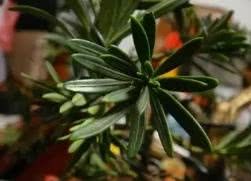
Previously, I knew about monk fruit, but not about Buddhist pine, and had never even heard of it. Later I learned that there is a bonsai called Buddhist pine, and I naively thought that monk fruit was produced by Buddhist pine, until one day I realized how ignorant I had been. Have you ever had the same confusion as the editor?
Podocarpus macrophyllus 'Maki'
The first one introduced is the most common, Podocarpus macrophyllus 'Maki'. It is a small-leaved Buddhist pine, and the most famous ones are "Zhejiang Luoque" and "Nantong Luoque", both of excellent quality. Its characteristics are that the leaf tips are relatively round, and the leaf veins are obvious, giving it a strong texture. Podocarpus macrophyllus 'Maki' is very pleasing to look at, so it has quite high ornamental value.
Taiwan Buddhist pine
Taiwan Buddhist pine is produced in Lanyu, Taiwan, China, hence its name. Unlike the dark green leaves of 'Maki', its leaves are emerald green and remain evergreen all year round. Its leaves are elliptical with obvious veins. It blooms from March to May each year, with yellow-green flowers growing in the leaf axils. When Taiwan Buddhist pine bears fruit, the red fruits it supports look very much like a Buddhist arhat wearing a kasaya, a vivid image. Moreover, Taiwan Buddhist pine is very tolerant of its growing environment and only needs sufficient sunlight and humidity, so it is very popular among collectors.
Japanese Buddhist pine
Japanese Buddhist pine is a relatively distinctive variety. Its trunk is dark gray, its leaves are lush, and it has more characteristics of a pine tree, with scaly cracking on the trunk and needle-like leaves. The flowers of Japanese Buddhist pine change as they grow, from white to purple or purplish red. The temperament of Japanese Buddhist pine is like that of a Japanese samurai, combining hardness and softness, yet never yielding.
Rice-leaf Buddhist pine
Rice-leaf Buddhist pine is very special. Unlike other varieties, it is a type of short-leaved Buddhist pine. It originally grew in southern China, and the rice-leaf Buddhist pine from Wenzhou is considered the best. In recent years, the grafting technique for rice-leaf Buddhist pine has become very advanced and is widely used, with a high success rate, so it circulates in large quantities on the market.
Pearl Buddhist pine
Pearl Buddhist pine is named for its leaves, which closely resemble pearls. Its leaves are relatively small and round, and when they first emerge they look like cute little red pearls. Pearl Buddhist pine is produced in Guangxi Mountain and Shengtang Mountain in China. Its numbers are rare, and it is very precious.
Island Buddhist pine
Island Buddhist pine can grow in sunny places and can also adapt to more shaded environments, belonging to semi-sun and semi-shade plants. Wild island Buddhist pine has been listed by China as a national second-class protected plant. Island Buddhist pine has an elegant temperament and high ornamental value, and is a potted plant variety very popular in every household.
After staying with the editor's introduction, do you have a better understanding and love for Buddhist pine? But be careful. When buying Buddhist pine, observe its characteristics to avoid buying fakes. Buddhist pine not only has high ornamental value, but its medicinal value is also not to be underestimated. In the editor's view, Buddhist pine is a gift from nature.