Anyone who keeps a cat should know how to grow cat grass. It really is very easy to grow.
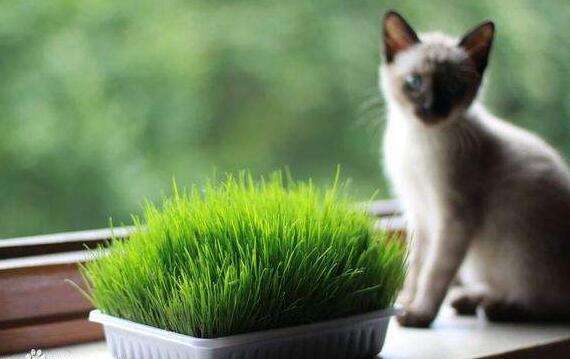
Cats like to eat grass, and every cat owner should know this. Cats eat cat grass not for fun, but because it can stimulate the cat's gastrointestinal motility and help the cat cough up hairballs that have formed into clumps in the stomach; it helps cats relax and relieve stress; it improves the oral environment, prevents and controls oral diseases, and supplements the corresponding vitamins and trace elements to suppress eosinophilic granuloma, oral ulcers, gingivitis, glossitis and other conditions caused by various factors. Cat owners living in cities can grow cat grass for their cats, and the method is especially simple.
1) Seed selection: it must be oat or wheat seeds. Oats or wheat bought from the supermarket cannot sprout. Cats generally prefer oat seeds.
2) Soaking: the seeds must be soaked, 12 hours in summer and 24 hours in winter. Put the seeds in a bottle, with about 3 times as much water as seeds. (Wheat is divided into summer wheat and winter wheat.)
3) Germination: this is very important. Pour out all the water in the bottle, turn the bottle upside down, and let the seeds spread evenly on the bottle wall (so that the moisture inside the bottle stays in the bottle). At this point temperature is very important, and it should be placed in a relatively warm environment. Only when you see small sprouts emerging from the seeds can you plant them. If there are no small sprouts, that means these are not seeds.
4) Planting: the soil must be nutrient soil bought from a flower and bird market; soil dug up from the neighborhood compound downstairs will not do. Sprinkle the seeds evenly on the soil and cover with about 0.5-1 cm of soil. Too much or too little will affect the seeds' sprouting. The flowerpot needs to be the kind with holes in the bottom.
5) Growing: water once each morning and evening, and water thoroughly. If it is cloudy, put it outside the window. If it is a very sunny day, it can only be exposed to the sun for at most 3 hours, and it must be moved indoors promptly.
6) When the grass grows to 7-8 cm, it can be given to the cat to eat. At this time the grass is at its tenderest, and after being nibbled it can grow one more round. After that the grass turns yellow and old, and cats no longer like to eat it. So the first round, when it is at its tenderest and best, should be enjoyed by your kitty in time.
7) Most cats will nibble it themselves. Some kitties do not like to eat it, so you can cut the grass into 4 mm pieces and mix it into canned food, and the kitty will eat every bit of it. Never cut the grass into dry food; the dry food gets damp, and cats simply do not like eating it that way.
8) Within a few days after eating the grass, the cat will vomit hairballs. They are yellow like poop, a very large clump, and some tightly wrap around the hairball. That means you have succeeded.
9) Cat grass must be watered every day, once each morning and evening, and watered thoroughly. Also, put the nutrient soil toward the bottom of the pot, and do not let the cat play with the soil or eat the soil, as there are bacteria in it.
Following this method, planting generally produces cat grass in 3 days, and in about 5 days it can be given to the cat to eat. If it does not grow, the problem lies in the germination step and in covering with too much soil.