How was the East Asian bonsai cultural sphere formed?
The formation and origin of bonsai art in China
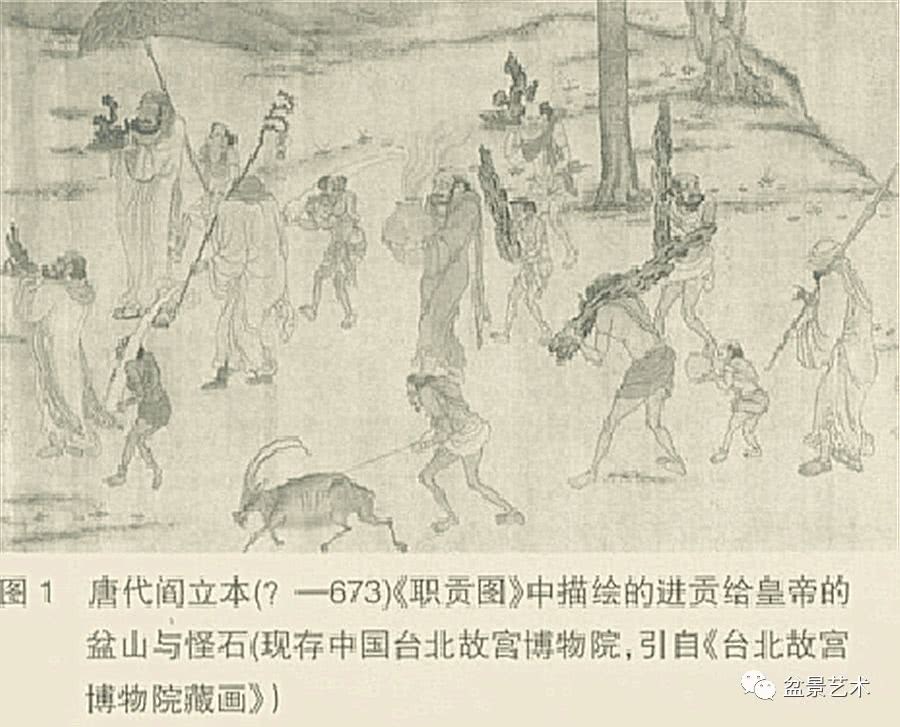
The formation of Chinese bonsai went through several stages: the primitive ancestors' nature worship, from nature worship to the Kunlun myth (sacred mountain belief), from the Kunlun myth to the immortal idea, from the immortal idea to the birth of the "one pond, three mountains" gardening technique, the art of shrinking land and the cosmic view of heaven in a pot, and the appearance and spread of the Boshan censer and inkstone mountain. It originated in the North China Plain during the Eastern Han Dynasty (25-220 AD) [2], thus opening the prelude to the approximately 2,000-year history of Chinese bonsai (Figures 1 and 2).
1.2The introduction of Chinese bonsai to the Korean Peninsula
According to historical records, under the influence of Chinese culture, in the last year of the reign of King Jinsa of Baekje in Korea (385-391 AD), pools were already being dug and mountains piled up in the royal palace, and flowers and trees were planted. At the same time, various other traditional cultures were also successively introduced from mainland China to the Korean Peninsula. Likewise, as early as 1,600 years ago during the Silla era, the Korean people, who loved nature and were rich in artistic talent, brought bonsai art back to the Korean Peninsula in the course of their exchanges with China. By the Goryeo period (918-1392), bonsai became popular among the upper classes; during the Joseon period (1392-1910), bonsai entered a stage of popularization and development (Figure 3); in modern and contemporary times (after 1910), especially beginning in 1978, bonsai became a hobby of ordinary people in South Korea and a bonsai craze arose.
The introduction of Chinese bonsai to Japan
According to the research of Dr. Ryoji Iwasa, although there are no definite documentary records, it can be inferred that the envoys to the Tang Dynasty brought the custom of planting trees and growing potted plants, which was popular after the early Tang period, to Japan. The famous Luoyang peony, as well as plum blossoms and chrysanthemums, which began to become popular among the Japanese people during the mid-Tang period, were brought back to Japan by these envoys to the Tang Dynasty. In addition, the earliest bonsai material in Japan is the "tree on a rock" depicted in the Kamakura-period "Saigyo Monogatari Emaki." This bonsai is a "pot mountain" or "attached-stone style," and should be closely related to the "bonsai" depicted in the mural of Li Xian's tomb in the early Tang period.
From the Heian period (794-1192) to the Kamakura period (1192-1333), large quantities of ceramics were imported from China to Japan. This can also be confirmed from ceramic fragments unearthed in various places. The unearthed ceramics are mainly celadon, along with blue-and-white porcelain, white porcelain, and Tenmoku ware. The unearthed sites are concentrated in Dazaifu and Kamakura, which were precisely the centers of Sino-Japanese cultural exchange during the Song Dynasty.
Likewise, the pots used for the bonsai appearing in the illustrated scrolls from the Kamakura period to the Muromachi period (1333-1555) are consistent, and Japan was in the midst of a craze for Chinese objects during this period. The bonsai pots of that time, like flower vases for ikebana, were also shipped from China to Japan, corresponding in date to China's Yuan Dynasty. For example, the deep drum-shaped pot in the "Honen Shonin Eden"; the pots for two pots of stone calamus in the "Kasuga Gongen Kenki E" are Chinese-made blue-and-white porcelain pots; the bag-shaped round pot planted with pine, the round pot with feet planted with plum blossoms, and the bag-shaped round pot with plum blossom pattern planted with crabapple in the "Muki Ekotoba" are all Jun ware or Guangdong pots.
In Japan, porcelain was first successfully fired in the second year of Genna in the early Edo period (1616, late Ming Dynasty in China) by the naturalized person Li Sanping, while the ability to fire glazed flower pots began around the Kyoho era in the mid-Edo period (1716-1722, the Yongzheng era of the Qing Dynasty in China). It can be concluded that the above-mentioned flower pots are imports from China, and the possibility that they date to the Yuan Dynasty or the late Southern Song period is the greatest, with the possibility of tracing back to the Northern Song or even the Tang Dynasty as well. Over the 400 years since the Kamakura period, the bonsai pots scattered in paintings of the Kamakura, Muromachi, and other periods were basically imported from China. Judging from the state of bonsai pots, the earliest opportunity for the establishment of Japanese tree bonsai was undoubtedly in China.
In short, under the influence of Chinese culture and bonsai, Japan saw the emergence of a custom of fondness for plants and an interest in small rock gardens among aristocrats and literati during the Nara period (710-794); during the medieval period (1192-1555), "trees on rocks" and pot stones began to be popular; subsequently began the trend of appreciating bonsai and pot stones in the Zen temples of the Five Mountains; during the Edo period (1623-1868), shoguns were often immersed in the hobby of bonsai flowers and trees (Figures 5-7); during the Meiji period (1868-1911), bonsai began to develop (Figure 8); by the Showa period (1925-1989), Japan had already reached an internationally leading level in many fields of bonsai.
The introduction of Chinese bonsai to Vietnam, Thailand, and the Philippines in Southeast Asia
Chinese bonsai was introduced to Vietnam at the end of the Five Dynasties period (907-959). Under the influence of Chinese Tang Dynasty culture, Vietnam began the history of "artificial rock gardens." The "Dai Viet Su Ky Toan Thu, Ben Ky" records: "In the former Le period, during the reign of the Great King, in the sixth year of At Dau (the second year of Yongxi of Song, 985), autumn, the seventh month. An artificial mountain was set up, and pleasure boats looked out from above. The fifteenth day of that month was the emperor's birthday. Boats floated on the river, and bamboo-made artificial mountains were carried in the boats. The mountain was called South Mountain. Since then, the 'ritual of boat theater' arose."
Vietnam's small rock gardens either refer to the natural plants planted on them and the rock mountain as a whole, or to exquisite artificial mountain-shaped objects. What is important is the reduced mountain, an artificial imitation of natural things. Over the course of more than 1,000 years of development, Vietnam has inherited and developed the custom of displaying such small rock gardens. Generally, in the courtyards of homes and temples there are many water
pools, and in the center of the water pool one or several small rockery stones are piled up, on which small flowers, grasses, and trees are planted, green moss is spread, and small models of houses, pagodas, and bridges are placed among the flowers and plants, embellished with small figures or animals. In addition, there are goldfish in the water. This water pool as a whole is called a "small mountain" in Vietnam (Figure 9).
The introduction of Chinese bonsai to Thailand. The people of Thailand have since ancient times loved cultivating crops, trees, and foliage plants for practical and ornamental purposes. Various plants are arranged in local parks and city parks, and works depicting plants can be seen in the paintings and sculptures of cultural relics. About 120 years ago, Chinese immigrants to Thailand brought bonsai-making techniques, and rapidly formed bonsai of native tree species suited to the climate and soil conditions of various parts of Thailand. Bonsai began to be cultivated and appreciated in various places, and quickly spread throughout the country, gradually forming a bonsai art unique to Thailand and matching Thai culture (Figure 10)
Figure 10Thailand's dancing bonsai
The introduction of Chinese bonsai to the Philippines. In 1590, the Spanish priest Pedro Cherino went to the Philippines to preach. In his book it is recorded that 16th-century Chinese brought bonsai to the Philippines for room decoration. This proves that bonsai had already been introduced to the Philippines in the 16th century or before.