Detailed Guide to Cultivating and Creating Winter Jasmine Bonsai
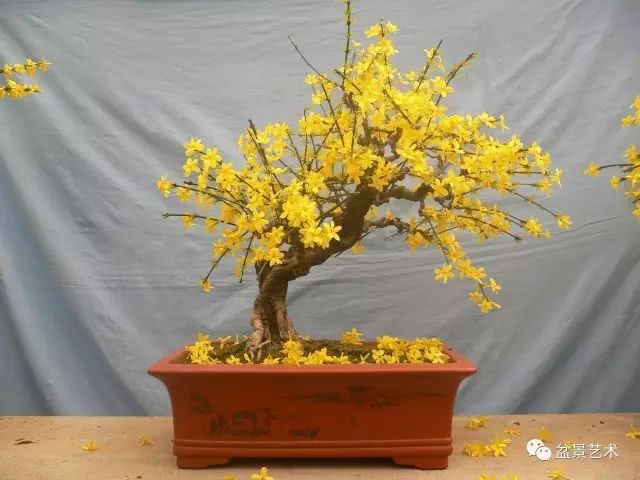
Winter jasmine, also known as golden belt, string of gold, Yunnan winter jasmine, large-leaved winter jasmine, and winter jasmine willow, is a deciduous shrub of the genus Jasminum in the family Oleaceae. Its branches are slender and graceful, growing in an arching, drooping form, reaching over 2 m in length. The side branches are sturdy, four-angled, and green. The compound leaves are trifoliate and opposite, 2-3 cm long, with ovate-elliptic leaflets that are smooth on the surface and entire at the margins. The flowers are borne singly in the leaf axils, with a goblet-shaped corolla, bright yellow, and the blooms are bright and elegant, with 6 lobes at the apex, or double-petaled. The flowering period is from March to May, lasting as long as 50 days. Besides being planted in courtyards, flower beds, and other places, it can also be grown in pots for ornamental purposes or made into bonsai.
Winter jasmine is also known as golden plum and small yellow flower. Because it is the earliest to bloom among all flowers, and after it blooms the spring of a hundred flowers blooming together arrives, it got its name. Together with plum blossom, narcissus, and camellia, it is collectively called the Four Friends in the Snow, and is one of China's precious flowers. Winter jasmine not only has elegant and beautiful flower colors and extraordinary temperament, but also has the characteristics of fearing no cold, being undemanding about soil and climate, and having strong adaptability, and has always been loved by people. It is native to the subtropical regions of South China and Southwest China. Cultivation is extremely common in the south, and it can grow in North China and Henan, and is cultivated and produced throughout Yanling County.
Winter jasmine loves light, tolerates slight shade, is slightly cold-tolerant, and fears waterlogging. In North China and Yanling it can overwinter outdoors. It requires a warm and humid climate, and loose, fertile, well-drained sandy soil. It grows vigorously in acidic soil and poorly in alkaline soil. Its roots have strong sprouting ability, and the parts of the branches that touch the ground root very easily.
Winter jasmine forms flower buds on 1-year-old branches and blooms in the spring of the following year. Therefore, after the flowers fade each year, all flowering branches should be shortened to encourage more side branches to grow, increase the number of flowers, and at the same time strengthen fertilizer and water management.
For winter jasmine pests and diseases, leaf spot and branch blight commonly occur, and can be sprayed with a 1500-fold dilution of 50% Tuzet wettable powder. Pests include aphids and bagworms, which can be killed by spraying with a 1000-fold dilution of 50% phoxim emulsifiable concentrate.
Potted winter jasmine should be repotted after leaf fall in winter and before sprouting in spring. The potting soil should preferably be loose, fertile sandy soil with good drainage and water retention. After planting, water thoroughly and place in a sheltered, sunny place for care. During the growing period, water only when the soil is dry, and water thoroughly when watering, avoiding water accumulation in the pot soil, otherwise it will cause root rot. After September, watering should be reduced to control excessive branch growth and help it overwinter safely. After the flowers fade each spring, apply decomposed organic liquid fertilizer 1 to 2 times to replenish the nutrients consumed by flowering, so that the plant can recover its growth as quickly as possible. From June to August is its flower bud differentiation period, when the use of phosphorus and potassium fertilizer can be increased, and attention should be paid to withholding water to favor the formation of flower buds. Fertilizing in autumn can increase the plant's cold resistance and promote the development of flower buds. Applying some fertilizer before flowering can not only make the flowers plump and beautiful, but also prolong the flowering period. Repot once every 1 to 2 years after the flowers fade in spring. The potting soil can be prepared by mixing equal parts of garden soil, humus soil, and sand, with a small amount of decomposed cake fertilizer, poultry and livestock manure, etc. added as base fertilizer. Combine repotting with pruning the plant, removing dead branches, diseased and pest-infested branches, and leggy branches. During the growing period, pay attention to pinching to encourage the plant to branch more and maintain a perfect tree shape.
The branches of winter jasmine are slender and soft. Besides normal weeping growth, they can also be woven into flower basket shapes, fan shapes, spherical shapes, peacock-display shapes, and other forms to increase ornamental value. If blooming is desired for New Year's Day or Spring Festival, the potted seedlings can be moved indoors to a sunny place 3 weeks in advance for cultivation, maintaining a temperature of 15°C to 20°C, and they will bloom on schedule. Winter jasmine flower branches kept in water will bloom in 5 to 7 days. It is an excellent material for winter cut flowers.
Winter jasmine can be propagated by division, layering, and cuttings. Division is usually carried out in spring and autumn, but early spring before the flower buds sprout is best. Layering or cuttings are generally carried out about one week after the flowers fade. When layering, first cut the bark of the branch to be buried with a knife to facilitate rooting. Cuttings can be done in a hotbed or directly in the open field. Select 2-year-old robust branches as cuttings, preferably 15 cm to 20 cm in length, bury 1/3 of the branch in soil, and keep the soil moist. Roots will form in 2 to 3 weeks. When the young roots change from white to yellow-brown, begin transplanting. In the early stage after transplanting, shade with a shade net or reed curtain for 5 to 7 days, and the survival rate of seedlings will be relatively high.
For making winter jasmine bonsai, choose plants that have grown for many years and have ancient, vigorous roots. They are mostly transplanted from winter to early spring. First plant them in clay pots to grow the raw material. Before planting, prune and shape the plant once, cutting off branches and root trunks not needed for the design, and shortening overly long branches. From the cut root trunks, select those with good shapes for cuttings. After they survive, plant them in small pots, and they become quaint and elegant miniature bonsai.
Winter jasmine is a trailing plant. Although its branches grow very quickly, it has no obvious trunk, and even relatively thick branches are hard to find. Therefore, the method of using roots in place of a trunk can be considered, lifting the gnarled and graceful roots above the soil surface to replace the trunk. Root lifting should be carried out gradually and must never be completed all at once, otherwise too many fine roots of the plant will be exposed, causing the tree stump to send out new shoots improperly, and in severe cases even causing the plant to die. The shaping of its root trunk should vary according to the tree, and different forms can be used, such as single-trunk style, double-trunk style, slanting-trunk style, curved-trunk style, bridge style, and lifted-root style. The crown mostly adopts the weeping-branch type, with branches naturally drooping in a waterfall shape. Pruning is used to make the branches well spaced and the flowering uniform. This form is the most common.
For the plum-stump style of winter jasmine bonsai, cut off the curved and drooping parts of the branches. If newly sprouted side branches also curve and droop, cut them off again. In this way, all branches can be kept straight, and when in bloom they resemble the sparse shadows and slanting branches of plum blossoms.
For the large-tree style of winter jasmine bonsai, choose plants that are gnarled and aged, with clearly defined trunk, main branches, and side branches, and train and prune the branches into clusters. During the growing period it looks like a large tree, but in fact the tree's foliage is composed of dense fine branches. Because suitable material is hard to find, this form is the rarest.
Winter jasmine bonsai can be shaped once before flowering, and pinched frequently during the growing period to encourage the branches to thicken and increase branching, which is beneficial for shaping. Branches that affect the tree shape should be cut off in time to maintain the bonsai's beauty. Other management is basically the same as for potted winter jasmine.