A passion like fire, quietly intense - Jatropha pandurifolia
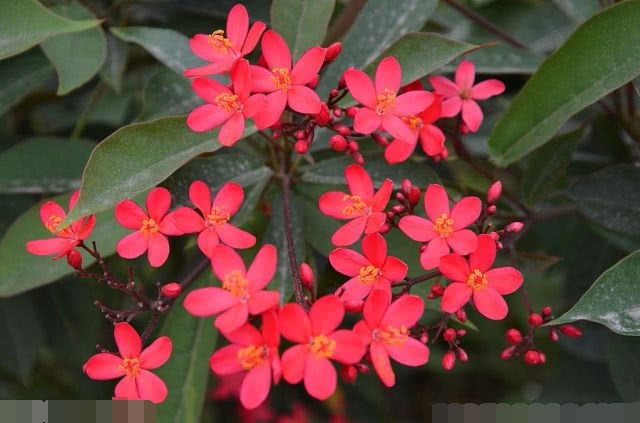
Jatropha pandurifolia, named for its fiddle-shaped leaves; also known as Jatropha integerrima, fiddle-leaf jatropha, peregrina, and Chinese jatropha, of the Euphorbiaceae family, genus Jatropha, is an evergreen shrub with red flowers; the plant has milky sap, and the sap is toxic. Native to the West Indies, it is widely cultivated in southern China.
Jatropha pandurifolia
Jatropha pandurifolia is an evergreen shrub with milky sap, about 1-2 m tall; leaves are simple and alternate, obovate-lanceolate, often clustered at the tips of branches. The leaf base has sharp spines, the leaf tip tapers to a point, the upper surface is deep green, the underside is purple-green, the petiole is downy, and the leaf surface is smooth. The inflorescence is a cyme, with 5 petals and a red corolla resembling cherry blossoms; it is a unisexual flower, monoecious, with male and female flowers borne on different inflorescences; there is also a pink variety. The capsule turns dark brown when mature. Blooming period: spring to autumn.
Although the flowers of Jatropha pandurifolia are not large, its blooming period is very long, and its bright red flowers can be seen almost all year round, as capricious as a little girl. Of course, to ensure it can bloom at any time, certain conditions are needed: during cultivation, the temperature must be suitable, and there must be adequate moisture for growth.
Jatropha pandurifolia
During the growth of Jatropha pandurifolia, special attention should be paid to the prevention and control of sooty mold. Sooty mold damages leaves, branches, and fruits; in severe cases it affects leaf photosynthesis, causing the plant to decline and reducing its ornamental effect. In the early stage of sooty mold, a layer of dark brown mold spots appears on the surface of leaves, branches, or fruits, and gradually spreads.
Jatropha pandurifolia
Although Jatropha pandurifolia is beautiful, it follows the principle that "beautiful things can only be looked at, not touched," and protects itself in this way. Its milky sap is toxic and must not be ingested by mistake. Accidental contact with the sap causes blisters or pustules, severe skin inflammation, and is also highly harmful to the eyes; if livestock accidentally eat fallen leaves, it can cause severe blistering of the mouth. First aid: if accidentally ingested, induce vomiting promptly; if touched accidentally, wash with plenty of water. If the condition is serious, send the person to the hospital for emergency treatment immediately.