Forgotten Love: The Chinese Mother's Flower - Daylily
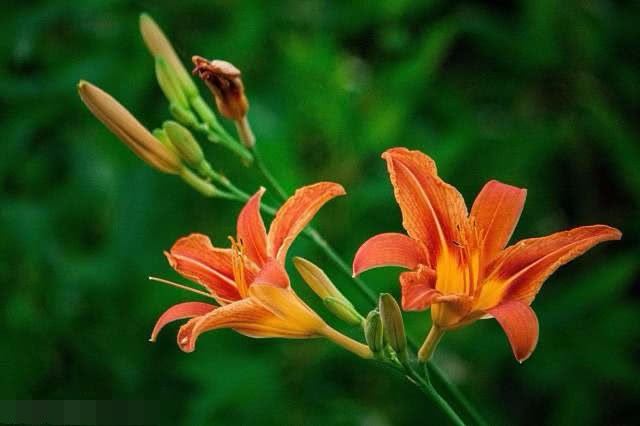
Hemerocallis is a perennial herbaceous plant with fibrous roots. It has a short rhizome and thick, spindle-shaped fleshy roots. Daylily has many aliases, including "golden needle," "yellow flower vegetable," "forget-sorrow grass," "yi nan grass," "cure-sorrow," "deer arrow," and others. In English, daylily is called "tiger lily." When eaten, it is mostly called "golden needle." Its leaves are flat, long and linear, and the underground stem is slightly toxic and cannot be eaten directly. As for the flowers, during the blooming period it grows slender green flowering branches; the flowers are orange-yellow, with very long pedicels, and are tubular like lily flowers. The fruit it produces has wings. It is commonly cultivated throughout the country, and grows wild in the provinces and regions south of the Qinling Mountains.
Daylily
Although daylily-type flowers originally came mainly from China, they were not improved much for a long time. After the 1930s, some American botanical gardens and gardening enthusiasts collected Hemerocallis plants produced in China, Japan and other countries for cross-breeding. There are now more than ten thousand cultivars, making them important ornamental and cut flowers, and also the category with the most cultivars among Liliaceae flowers.
Daylily
Daylily is not the same as yellow flower vegetable. Yellow flower vegetable is one type of Hemerocallis plant, but most Hemerocallis plants other than yellow flower vegetable are inedible. The daylily flowers we commonly grow for enjoyment are not yellow flower vegetable, but large-flowered daylily, tiger lily and the like; yellow flower vegetable generally appears in vegetable plots, not in flower beds. Never pick "daylily" from a flower bed to eat, to avoid poisoning. Yellow flower vegetable flowers are relatively slender and long, with narrower petals and a tender yellow color. The flowers of ornamental daylilies are closer to somewhat funnel-shaped lilies, and the flower color is generally orange-yellow, with some even close to red. Fresh yellow flower vegetable contains a small amount of colchicine, and should first be made into a dried product, then cooked at high temperature or stir-fried before eating. Orange-yellow and orange-red daylilies contain a large amount of colchicine, and even if blanched repeatedly in hot water, they cannot be eaten. If eaten by accident, it will irritate the gastrointestinal tract and respiratory system, and also cause dry mouth, diarrhea and dizziness. Because the flower shapes are similar, many documents confuse daylily and yellow flower vegetable. Please remember clearly: if a text says daylily can be eaten, it definitely refers to the yellow flower vegetable in a vegetable plot, not the daylily flower in a flower bed.
Daylily
Meaning:
Chinese Mother's Flower
Long before the carnation became a symbol of maternal love, our country also had a mother's flower, and it was the daylily flower.
Flower Language
1. Forgotten love. Daylily is also called forget-sorrow grass, representing "forgetting all unhappy things."
2. Let go of him (her), let go of sorrow.
3. Hidden feelings.
4. The flower language of daylily is the forgetting of love.
5. At the same time, it is also China's mother's flower.