What Kind of Plant Is a Thistle? Getting to Know Scotland's National Flower
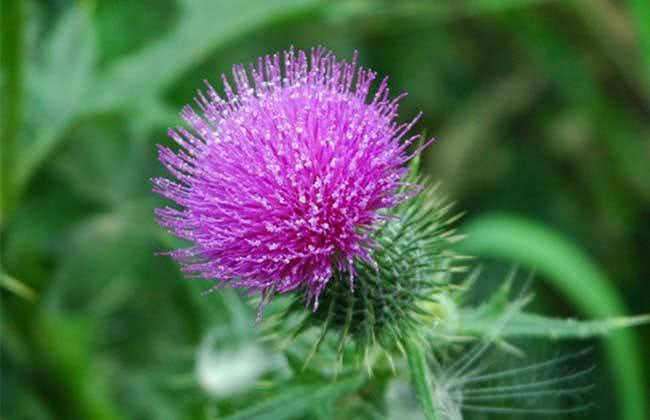
Thistle [jì] is a plant of the genus Cirsium in the Asteraceae family. It is distributed in Korea, Japan, Taiwan, China, as well as in Henan, Anhui, Jiangsu, Hebei, Shanxi, Shandong, Shaanxi, Jiangxi, Yunnan, Hunan, Fujian, Hubei, Guizhou, Guangxi, Guangdong, Sichuan, Zhejiang and other places in mainland China, growing at elevations of 400 m to 2,100 m, generally in wasteland, grassland, mountain slopes and forests, roadsides, thickets, fields, forest edges and beside streams. It is sometimes cultivated artificially for medicinal use. Its flower meaning is prudence, rigor, steadiness, and silent love.
Thistle
Perennial herb, with tuberous roots spindle-shaped or turnip-shaped, up to 7 mm in diameter. Stem upright, 30(100)-80(150) cm, branched or unbranched; all stems and branches have ridges, covered with dense or sparse multicellular long jointed hairs; the lower part below the capitulum is grayish-white, covered with dense tomentum and multicellular jointed hairs.
Thistle
The base has white filamentous hairs. Basal leaves are stalked, not falling off at flowering time, oblanceolate or obovate-elliptic, 15-30 cm long, green on the surface with sparse long hairs, with long hairs on the veins on the underside, pinnately lobed at the margin, with 5-6 pairs of lobes, long elliptic, with spines on the lobe margins; middle leaves are long elliptic, sessile at the base, stem-clasping, pinnately parted at the margin, spiny, and the upper leaves gradually become smaller. The capitulum is terminal, spherical; the involucre is 3.5-2 cm long and 3-4 cm wide, with cobweb-like hairs outside, and the involucral bracts are in multiple layers, linear-lanceolate. The outer layer is shorter than the inner layer, with an acuminate apex and short spines; the innermost layer is longer and spineless; the flowers are purple or rose-colored, with a slender corolla tube and unequal corolla lobes. The achene is long elliptic, and the pappus is feathery, slightly shorter than the corolla, dark gray. The flowering period is June-August. Breaking the leaves of a thistle will release a white milky liquid. Thistle has an astonishing ability to repair itself: if its stem is broken, new shoots will sprout directly from the broken surface.
Thistle
The whole plant is used as medicine, to treat heat-induced bleeding; the leaves are used to treat blood stasis, and externally to treat malignant sores. The whole plant contains alkaloids and volatile oils. The fresh leaves contain cirsium glycoside. Its root used as medicine has the effects of cooling blood and stopping bleeding, and removing blood stasis and reducing swelling.