What flowers and plants are suitable for a north-facing balcony? Pick the right ones and it will still be lively
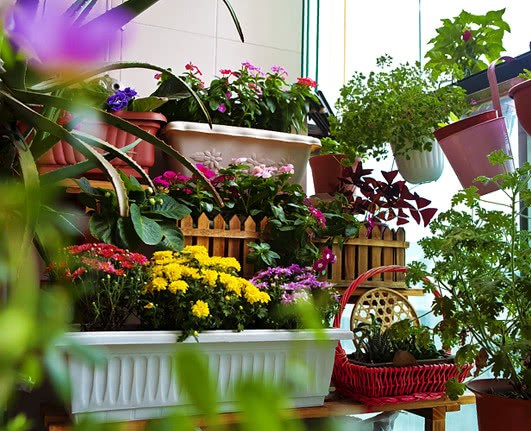
For gardening friends who love growing flowers and plants, a north-facing balcony is nothing but a chicken rib - a pity to discard, yet hopeless to use. Even when the sun is shining brightly and the opposite floor is full of thriving greenery, the north-facing balcony remains dim and lightless, and choosing the wrong plants makes it look even more bleak and miserable.
Having a north-facing balcony is already a missed feng shui treasure spot, and what is more sorrowful than sorrow is watching the plants you grow grow sparser and thinner day by day. Don't even think about shaping a pot of petunia into a ball - scattershot blooming is already its way of repaying your nurturing grace; a pot of chrysanthemum that was supposed to be a thousand-flower chrysanthemum, after one summer, makes you think you planted a pot of garland chrysanthemum! Put together a Crassulaceae succulent platter, and wow, it stretches out and drops leaves until it turns into little toothpicks. What can save you, my north-facing balcony?
A balcony needs a base tone
Squirrel Jun thinks that to bring a north-facing balcony back to life, it must be arranged in a well-layered and orderly way. For the background wall, window edge and railing, you can choose these climbing plants to do the job, and the three-dimensional sense of space instantly increases, such as Madagascar jasmine, bougainvillea, honeysuckle, and cypress vine.
Madagascar jasmine, with twining stems that are soft yet tough, spirals upward along a support, and its flowers are typical representatives of the oleander family, pink like trumpets, large and upright.
Bougainvillea, rather than planting it in the ground, it is better to let it climb on a wall or frame. Plant mad scientists even make their own grafted varieties, grafting flowers of multiple colors onto one plant - red, pink, white and orange flowers blooming on a single plant, full of fun and excellent for viewing.
Honeysuckle, initially white when it opens, turns yellow after one or two days, hence the name honeysuckle. Honeysuckle flowers always bloom in pairs, two flowers on one branch, inseparable.
Cypress vine, as long as you give it a trellis, green leaves and red flowers will cover the whole frame - basically this is guaranteed. Its feathery green leaves layer upon layer, light and graceful, occasionally spitting out a few five-pointed red flowers as accents. For cypress vine to grow well, properly thin out the vines and branches and leaves, and promptly remove spent flowers after blooming, so as to develop new branches and extend the flowering period.
Top choices for year-round companions
Once the balcony has its base tone, you should move your view to the middle. Woody plants are mostly flowering and perennial, and to add liveliness there should be these: Chinese rose, camellia, gardenia, Daphne odora, and hydrangea.
Chinese rose, fragrant and free-flowering, you can smell its scent throughout a balcony, with many choices of flower shape and size. Each time it first blooms, observe the buds carefully - they are like little peaches. One of the must-have woody plants for balcony growers.
Camellia, evergreen all year round, with glossy leaves. Camellia leaves are large in area and have high transpiration, so moisture retention must be done well. When pairing with camellia, it is suitable to choose small plants; large green leaves are out of the question as they look rather uncoordinated.
Gardenia, can be grown for many years, with huge double flowers, flower color as white as jade, and a fresh, rich fragrance. If grown well, it blooms every summer, with buds beginning to form from spring, from tender green buds until slightly whitish.
Daphne odora, its fragrance is quite special, like fresh citrus, not as pure as osmanthus or jasmine, nor as warm and elegant as orchid or lavender. The first time you smell it, you may find the scent too intense, and up close it is even a bit pungent. If placed together with other flowers, the other flowers seem to lose their fragrance faintly.
Hydrangea, very sensitive to soil pH, and soil pH directly affects flower color. When the pH value is 4 to 6, on the acidic side, the flowers are blue-purple; when the pH value is above 7.5, on the alkaline side, the flowers are pink. To make hydrangea bloom in different colors, during the bud formation period you can apply aluminum sulfate or lime to adjust soil pH and change the flower color.
The window sill classic is still red flowers paired with green leaves
The lively blooming of flowers cannot lack the foil of green leaves. Leave the important task of providing contrast on the north-facing balcony to them: yew, jade plant, red maple, and coral bells.
Yew, grows at a snail's pace and is easily forgotten. For newly purchased yew, the branches and leaves are lush and transpiration is high. To prevent the top leaves from curling and drying, it is best to prune appropriately, reduce excessive consumption, keep the potting soil slightly dry, and speed up the restoration of normal supply.
Jade plant, under appropriate water, fertilizer and sunlight, quickly grows into a large tree, with plump leaves so fleshy that the leaf stalks are almost invisible. The juicy emerald succulent leaves blush after a little sun, showing pink leaf edges.
Red maple, the best viewing period is when the new leaves have just unfolded. Red maple has strong sprouting ability and often grows new buds on the trunk. If you remove all the leaves in late summer and apply fertilizer once, in about twenty days new leaves can grow again, adding another viewing period.
Coral bells, at first the leaf veins are not obvious, and after one or two days of gradual change, some varieties even change leaf color - truly a growth process full of surprises. Choose five or six varieties and plant them together to create a very strong visual impact.
By the window sill on a cloudy evening, in the future there will always be flowers and plants sprouting~
Look left, look right, look forward, wait a few days for the buds to bloom~
Welcome to follow Plant Fanatic, Squirrel Jun chats with you about flowers and plants!