Fuzzy Cotyledon succulents: besides Bear's Paw, what other varieties are there?
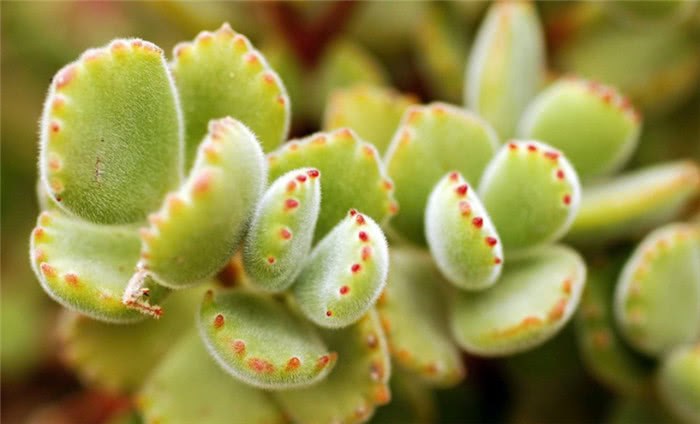
Among the many succulent plants, there is a very typical succulent variety, namely the Cotyledon genus succulents. The most notable features of Cotyledon succulents are that the plants are small, the leaves are round and plump, and they grow fuzz and a waxy coating. In the large family of Cotyledon succulents, there are also many beautiful varieties. Besides the more familiar Bear's Paw, there are quite a few other varieties too! Next, the old gardener editor will introduce them to you one by one.
First, Bear's Paw
Bear's Paw also has two other names, namely Bear Paw and Green Bear. It belongs to a succulent plant of the Crassulaceae family, Cotyledon genus, and its place of origin is Cape Province in South Africa. The Bear's Paw plant is small and exquisite, and its leaves take an oval shape, round and plump, light green in color. Even more amazing is that along the edges of the leaves grows a row of purplish-red serrated teeth; seen from a distance, they look just like the little paws of a bear, making people unable to put them down after looking. Because Bear's Paw is a typical subtropical plant variety, it is very suited to growing in a warm, dry environment with plenty of sunlight. However, it also has a certain tolerance for partial shade and resistance to cold, but the editor still wants to remind everyone that Bear's Paw is rather afraid of high temperatures; when the ambient temperature reaches 35°C, its plant can easily be sunburned.
Second, Daruma Fukuniang
Daruma Fukuniang is also a succulent plant of the Crassulaceae family, Cotyledon genus, and it is also called Maruba Fukuniang. It is native to the central and southern regions of North America. Because it has strong ornamental value, it has won the affection and praise of many flower lovers. Daruma Fukuniang also belongs to a shrub variety among succulents. Its plant is compact, its stems are soft, and its leaves are plump and full, crystal clear, with a color mixing red and yellow, just like strings of crystal-clear grapes. Like the characteristics of other succulent plants, Daruma Fukuniang also very much likes a growing environment with plenty of light and warm, dry conditions, and it has a certain ability to withstand cold temperatures. Because Daruma Fukuniang very much likes plenty of light, when we cultivate it, we should best use full-day sunlight and ensure an adequate water supply, so as to guarantee the good growth of Daruma Fukuniang.
Third, Ping Pong Fukuniang
Ping Pong Fukuniang is also a succulent plant variety of the Crassulaceae family, Cotyledon genus. Among the Fukuniang succulents, Ping Pong Fukuniang is a hybrid variety. Although it has not been around for very long, it has won the favor of many flower lovers with its pretty flower form. The Ping Pong Fukuniang plant is elegant and distinctive, and its leaves take an oval shape, grayish-white in color with a slight pale pink, and on top there also grows a layer of white fuzz, looking just like ping pong balls. Ping Pong Fukuniang rather likes a growing environment with plenty of sunlight and warm, dry conditions. In view of this characteristic of Ping Pong Fukuniang, when we cultivate it, we should adopt a full-sunlight method and ensure a suitable ambient temperature, as this is more conducive to its growth.
Fourth, Little Sticky
Little Sticky is also a succulent plant variety of the Crassulaceae family, Cotyledon genus. Its place of origin is Cape Province in South Africa. The Little Sticky succulent plant is compact and dense, with round and plump leaves, yellow-green in color, and there is also a peach-red line at the edge, looking very beautiful. In addition, the leaves of Little Sticky can also secrete a sticky liquid, which is why people gave it such a vivid name. The Little Sticky succulent is very suited to a warm, dry, and well-ventilated growing environment. Besides that, the Little Sticky succulent also has a certain drought tolerance and ability to tolerate poor soil. Generally, as long as you replenish water for the Little Sticky succulent about once every ten-plus days, it can grow very well.
After listening to the old gardener editor's introduction, do you have a newer understanding of these Cotyledon succulents? How much more do you know about the topic of this article? You are welcome to express your views in the comment section below. If you like this article, you might as well subscribe, and more wonderful articles will be shared with you.