What makes Anacampseros telephiastrum 'Variegata' unique?
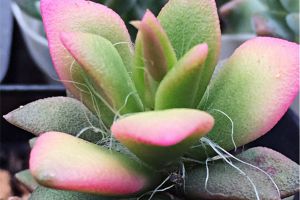
Common names of Anacampseros telephiastrum 'Variegata'
Anacampseros telephiastrum 'Variegata' is also called Anacampseros rufescens 'Variegata' (sunrise succulent).
Habits of Anacampseros telephiastrum 'Variegata'
Anacampseros telephiastrum 'Variegata' is a plant of the genus Anacampseros in the family Portulacaceae, and summer is its most suitable growing season.
It likes a warm, dry and sunny environment, and grows best at 18~25°C.
It is not cold-tolerant, and tolerates partial shade and drought. It dislikes wet conditions and strong light.
For home care, sowing and cuttings are commonly used for propagation. Common pests and diseases include: anthracnose, whitefly.
Care tips for Anacampseros telephiastrum 'Variegata'
Repotting: repot every spring. It is a shallow-rooted succulent plant; if watered too much or if the potting soil drains poorly, the roots are prone to rot from moisture, and it can only be saved by re-planting cuttings immediately.
Watering: when the weather is dry, mist around the flower pot, but do not spray water on the leaves. In winter, when room temperature is low, keep the potting soil dry.
Fertilizing: fertilize once a month during the growing seasontime.
Light and temperature: in spring and autumn it can take full sun; in summer, pay attention to shading, as long as it does not get sunburned.
Propagation methods of Anacampseros telephiastrum 'Variegata'
Sowing: in April~Maysow indoors in pots, the germination room temperature is20~25°C, after sowing15~21days to germinate, and the seedlings grow relatively fast.
Cuttings:5~6carried out in the month, cut robust, plump top stems and leaves, with a length of3~4cm, about7~8leaves, let them dry slightly, then insert into a sand bed, keep the soil slightly dry, after insertion21~27days to root.
Suggested planting combinations: Graptoveria 'Titubans', Sedum adolphi
Additional notes: as Anacampseros telephiastrum 'Variegata' grows, spiderweb-like white silky hairs will twine around the leaf axils, giving it considerable ornamental value; other plants in the genus Anacampseros: Anacampseros rufescens, Anacampseros papyracea.