This inconspicuous little yellow flower in the wild is so beautiful, and many people have never seen it.
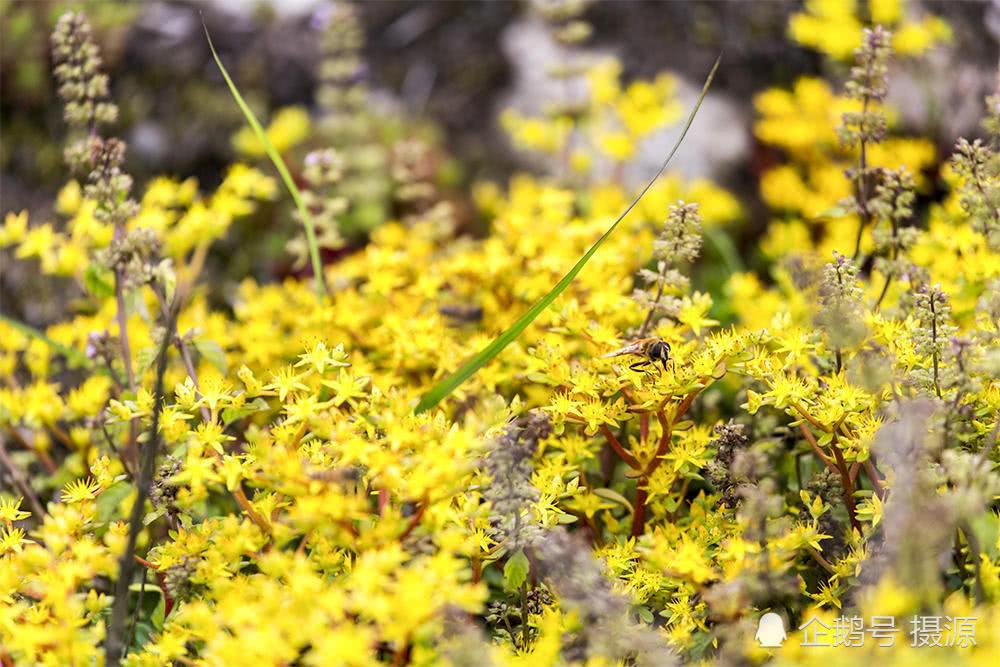
Stringy stonecrop (scientific name: Sedum lineare Thunb.) is a perennial herbaceous plant in the Crassulaceae family, hairless. The stems are 10-20 cm tall. Leaves are in whorls of 3, rarely in whorls of 4 or opposite, linear, with a bluntly pointed tip, a sessile base and a short spur. The inflorescence is a cyme, terminal, sparsely flowered, with a single short-stalked flower in the center; the sepals are linear-lanceolate. The follicles are slightly divergent, with short styles; the seeds are small. The flowering period is April-May, and the fruiting period is June-July.
It is found in Yunnan, Sichuan, Guizhou, Guangdong, Hunan, Hubei, Gansu, Shaanxi, Henan, Anhui, Jiangsu, Zhejiang, Fujian, Taiwan, China and Jiangxi in China. It grows on grassy slopes in low mountains or flat land. It also occurs in Japan. The whole plant is used medicinally, with effects of clearing heat and detoxifying, dissipating blood stasis and reducing swelling, and stopping bleeding.
Potted cultivation: Stringy stonecrop has delicate plants and beautiful flowers, and its emerald-green small leaves are like jade, neat and attractive, so it can be grown in pots for appreciation (container planting). Ground cover: Stringy stonecrop is an excellent ground cover plant. It not only grows fast and has strong spreading ability, but its root system is crisscrossing and tightly combines with the soil, which can prevent the surface soil from being washed away by rain, making it suitable for use as a slope-protection grass.
Stringy stonecrop has extremely strong adaptability and is not choosy about soil. It can grow on relatively thin substrate, has extremely strong drought tolerance, and also has fairly strong cold resistance. In summer, when the roof temperature reaches as high as 50-55°C and there is no rain for 20 consecutive days, this grass will not die. When cultivated in northern China, it grows very well in all three seasons of spring, summer and autumn. During severe cold periods, the aboveground stems and leaves freeze and wither, and it enters a dormant period; once the soil thaws the following year, new buds sprout, and by early spring it can already cover the ground.
Medicinal use. Whole plant: sweet, slightly sour, cool. Clears heat and detoxifies, reduces swelling and discharges pus, relieves pain, and treats jaundice. Used for sore throat, hepatitis, carbuncles, swellings and sores, venomous snake bites, shingles, and burns and scalds.