What other names does the lily have? The one you know may just be one of its aliases
Alternative names
The lily is also called "Shandan", "Zhongting", "Zhongfeng flower" and "Yehе flower", among other names. It is a perennial herbaceous bulbous plant belonging to the genus Lilium in the family Liliaceae.
Morphological characteristics
The lily plant is usually about 40-60 cm tall, and can reach about 150 cm at its tallest.
The lily's stem is divided into a bulb and an above-ground stem. The bulb is a pale white sphere made up of numerous egg-shaped, spoon-like, fleshy, thickened scales; the above-ground stem is upright and cylindrical, green overall, hairless, and usually bears purple spots.
The lily's roots are divided into fleshy roots ("basal plate roots") and fibrous roots ("upper plate roots", "adventitious roots").
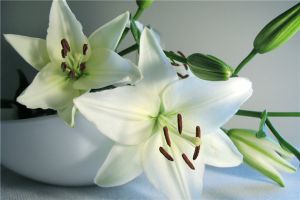
The lily flower grows at the top of the stem, either singly or in clusters, and is characterised by a large corolla and a long floral tube, with an overall funnel shape. The flower colour is mostly white, but because there are so many varieties, flowers of all kinds of colours can also be seen, and they are very beautiful.
Growth habits
A semi-shaded environment with both ample sunlight and moist soil is most favourable for the growth of lilies.
High temperatures and drought are both unfavourable to their growth, and lilies are also rather weakly cold-tolerant. A temperature of 16-24°C is the optimum temperature for lily growth; temperatures below 5°C and above 30°C will bring lily growth almost to a stop, and only above 10°C can normal plant growth be guaranteed.
When choosing soil, priority should be given to soil rich in fertiliser and humus; never use hard clay, and slightly acidic soil is best; secondly, ensure good drainage.
Value and uses
Ornamental value: the ornamental value of the lily is what the public knows best, and the lily flower has a reputation as the "fairy in cloud garments". Its pure, elegant appearance has made the lily a symbol of the Virgin Mary in Catholicism, and the Vatican has adopted the lily as its national flower, symbolising the nation's independence and economic prosperity. Because the bulb is formed by many scales coming together, it also carries the beautiful meanings of "a harmonious union lasting a hundred years" and "all things going as one wishes", and it has been an indispensable auspicious flower at Chinese weddings from ancient times to the present. Whether in parks or on all kinds of occasions, it appears as a precious decorative flower.
Edible value: the lily's bulb is rich in starch, and some varieties are regarded as a fine ingredient; in particular, Lanzhou lilies from China are especially famous for their edible value. Lanzhou lilies taste sweet and are large in size, and can be used both in pastries and in dishes. Lilies can also be made into dried lily and lily powder.
Medicinal value: the lily also has good medicinal value. In traditional Chinese medicine, the effects of the lily include clearing heat, moistening the lungs and calming the mind. Both the flower and the bulb can be used as medicine, so its uses can be said to cover both medicine and food.
Flower meaning
For Chinese people, the lily has long carried meanings such as "a harmonious union lasting a hundred years", "family harmony" and "all things going as one wishes", with deep connotations of blessing.
In addition, the lily flower also symbolises a pure and unsullied character.