Tuberose has an advantage when grown in a suitable environment
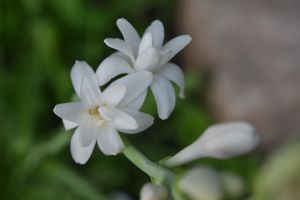
The family and genus of tuberose
Tuberose belongs to the Amaryllidaceae family. It is a perennial bulbous flowering plant and a bulb flower.
Other names for tuberose
Tuberose is what people often call "moonlight fragrance" and "night-blooming flower."
The origin of tuberose
It is native to Mexico and South America, and is cultivated more in northern China than in the south. In recent years, some flower farmers in towns such as Xinhe and Shucheng in Shuyang County, Jiangsu Province, introduced and trial-planted it, achieved success, and earned relatively high incomes. It and the tropical American night-blooming flower do not belong to the same family.
The morphological characteristics of tuberose
Tuberose is a winter-dormant plant, with linear basal leaves and short, small stem leaves.
The spike-shaped flower cluster is terminal, with each spike bearing 12-32 flowers. The flowers are white, funnel-shaped, and have a rich fragrance, with the strongest scent at night, which is how it got its name.
When planted in the open ground, the flowering period is usually from early July to early November, with the peak flowering period from August to September, making it a summer cut-flower species. It grows about 80 cm tall, with basal, lanceolate leaves that are slightly reddish at the base.