What are the alternative names of the giant spider lily? A complete guide
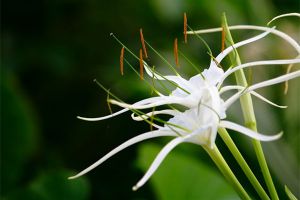
Alternative names of the giant spider lily
Its alternative names include Wenzhulan, Wenlanshu, Luoqundai, Shuijiao, Haijiao, Yujiao, Yumilan, Haidaiqi and so on.
Morphological characteristics of the giant spider lily
Crinum asiaticum:A robust herbaceous perennial. It has long columnar bulbs. The whole plant has roughly fewer than 30 leaves, arranged in multiple rows and lanceolate in shape, reaching up to about 1 m at the longest, with a width of about 7-12 cm, possibly even wider, tapering from base to tip in an acuminate manner, with a pointed tip and dark green edges. Its flower stem is erect, almost equal in length to the leaves; it bears about 10-24 flowers in an umbellate inflorescence; the pedicels are about 0.5-2.5 cm long. The fruit is subglobose, about 4 cm in diameter, containing one seed. Its flowering period is in summer.
Crinum amabile:It differs from Crinum asiaticum in its spherical bulb and does not have wavy leaves. The plant height is about below 60 cm, and it is distributed mainly in tropical Asia. Its flowers are slightly more regular than those of Crinum asiaticum, and the flowers mostly open together; generally the flowers droop before opening.
Crinum augustum:Its plant form is not very different from that of Crinum asiaticum, and the flower shape is just as irregular as that of the giant spider lily, with the flowers also bearing a touch of the vivid red of Crinum zeylanicum.
Growth habits of the giant spider lily
The giant spider lily likes warm, humid environments with ample light and fertile soil. It is not cold-tolerant but tolerates saline-alkali soil. However, during the seedling stage it must not be exposed to direct sunlight. The suitable growing temperature is 15-20°C. In winter, during the bulb's dormant period, the storage temperature should be kept at around 8°C.
For pot cultivation, a sandy growing medium with high humus content, fertile leaf mold and strong permeability is suitable.
The flower language of the giant spider lily
Holding your hand, growing old together with you; walking alongside you, the love of a married couple.