What plant is Bleeding Glory-Bower? Let us truly get to know it
Other names for Bleeding Glory-Bower
Mali, Pearl Pagoda
Morphological characteristics of Bleeding Glory-Bower
Climbing shrub, 2-5 m tall; young branches four-angled, covered with yellowish-brown short tomentum, becoming hairless when old; the pith of young branchlets is loose when young and hollow when old.
Leaves papery, narrowly ovate or ovate-oblong, 4-10 cm long, 1.5-4 cm wide, apex acuminate, base nearly rounded, margin entire, surface covered with small wart-like hairs, slightly rough, nearly hairless on the underside, basal veins three; petiole 1-2 cm long.
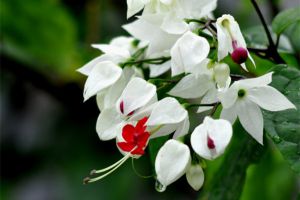
Cymes axillary or falsely terminal, dichotomously branched. Calyx white, connate at the base, swollen in the middle, with 5 ridges, deeply 5-lobed at the apex, covered with fine hairs on the outside, lobes triangular-ovate. Corolla deep red, forming a striking color contrast with the white calyx, with a strong visual impact.
Growth habits of Bleeding Glory-Bower
Bleeding Glory-Bower prefers a warm, humid, semi-shaded environment with plenty of sunlight, and is not cold-tolerant.
Main values of Bleeding Glory-Bower
Ornamental: It is a beautiful ornamental plant. When in bloom, the deep red corolla extends from within the white calyx, resembling spitting pearls. The flower shape is unique and the blooming is profuse.
Medicinal: To treat postpartum hemorrhage and abdominal pain: take 2 liang (100 g) of fresh Bleeding Glory-Bower, place it in a pot, spray with wine and stir-fry, spray again and stir-fry again until slightly scorched; add a handful of edible rice and decoct in water to serve.
To treat snake and insect bites: take 4 liang (200 g) of dried Bleeding Glory-Bower and soak in 20 liang (1,000 g) of wine (usable after two weeks). For any use, take the medicine and apply it to the wound, and also take a small cup of this wine orally.
The flower language of Bleeding Glory-Bower
Precious and pure, with a warm and sincere heart