What are the characteristics and growing habits of the rose of Sharon?
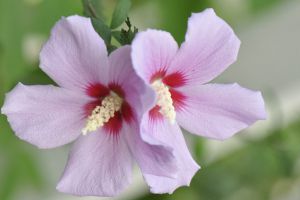
Other names for the rose of Sharon
Cotton rose, vitex twig, flower that opens in the morning and falls at dusk, morning glory
Growing habits of the rose of Sharon
The rose of Sharon is highly adaptable to its environment, is relatively tolerant of dry and poor soil, and is not strict about soil requirements; it prefers a warm and humid climate. It tolerates slight shade, moisture, pruning, heat and cold, and likes warmth. However, when cultivated in northern regions it needs protective overwintering. It likes moisture but is also drought-tolerant, is not strict about soil requirements, and can even grow in heavy clay. It has strong suckering ability.
Variety classification of the rose of Sharon
Common varieties of the rose of Sharon include: the Korean series; the white single-center series; the red single-center series; the purple single-center series; the blue single-center series; the Asda series and the seaside series.
Common variants include:
1. White double-flowered rose of Sharon. The white petals have thin purplish-red lines and small spots, double-flowered.
2. Glass double-flowered rose of Sharon. The branches are straight, the flowers are double, and the color is sky blue.
3. Purplish-red double-flowered rose of Sharon. The petals are purplish-red or whitish, double-flowered.
4. Variegated-leaf rose of Sharon. The leaves bear white spots, and the flowers are purple and double.
Uses of the rose of Sharon
1. Ornamental use. The rose of Sharon blooms in summer and autumn, has a very long flowering period, and has many variants and varieties in flower color and flower form, making it an excellent ornamental flowering tree for gardens. It is often used as hedging and foundation planting material, is suitable for group planting on lawns, roadsides or forest edges, and can also be used as a green hedge or planted together with other flowering trees and shrubs. Because its branches are soft and tolerate pruning, it can be shaped into stump bonsai or potted plants. At the same time, it also has strong resistance, making it an excellent tree species for greening factories and mines.
2. Medicinal value. The rose of Sharon flower contains saponarin, a flavonoid glycoside, and also contains isovitexin. In addition, it contains saponins and mucilage. The root contains tannins and mucilage. The seeds contain fatty oil. The rose of Sharon flower clears heat and cools the blood, resolves toxins and reduces swelling. It treats dysentery, bleeding hemorrhoids, leukorrhea, sores, boils and carbuncles, and scalds. The root clears heat and resolves toxins, promotes urination and reduces swelling, and relieves cough. It treats cough, lung abscess, intestinal abscess, swollen and painful hemorrhoids, leukorrhea, and scabies. The root bark and stem bark can clear heat and drain dampness, kill parasites and relieve itching. They treat dysentery, prolapse of the rectum, scrotal eczema, athlete's foot, and so on. The fruit is called "zhaotianzi" and can clear the lungs and resolve phlegm, resolve toxins and relieve pain. It treats phlegm-induced wheezing and cough, neurotic headache, and impetigo.
Washing the face with water in which rose of Sharon flowers have been boiled can beautify the complexion; washing the hair with the juice of the leaves can treat scalp ringworm, makes the hair easy to comb, nourishes beautiful hair, can make the hair naturally black and glossy, and can remove dandruff. The rose of Sharon is also a natural detoxifier. If toxic substances in the air, such as sulfur dioxide, reach one part in 100,000, people cannot work for long periods; when its concentration reaches four parts in 10,000, people will die of poisoning. Yet some plants have the ability to detoxify themselves, breaking down toxic substances within their bodies and converting them into non-toxic substances. The rose of Sharon is one of them and is called a "natural detoxifier".
3. Edible value. In the Tingzhou area of Fujian, deep-fried rose of Sharon flowers are made by mixing the flowers with flour and then putting them in an oil wok; the flower shape can still be faintly seen, and they have color, aroma and taste all at once. They are called "flour flowers" and are a delicacy at flower banquets. The famous rose of Sharon and tofu soup of Huizhou in Anhui is made by cooking rose of Sharon flowers together with tofu; it has a floral fragrance, the tofu is fresh and tender, and it is fragrant, smooth and delicious. Preparing rose of Sharon flowers as a dish is simple: they can be served cold-dressed, stir-fried or made into soup. Their texture is crisp and tender, delicate, smooth and delicious, with a light fragrance; they can moisten dryness and remove damp-heat, making them a natural health food.
The flower language of the rose of Sharon
Resilience, eternal beauty, gentle persistence.
Rose of Sharon flowers open in the morning and fall at dusk, but every fading is for the sake of an even more splendid bloom the next time. It is like the sun that keeps setting and rising again, like spring leaving and autumn coming as the four seasons turn, yet life goes on endlessly. It is even more like loving a person: there will be low points and there will be disturbances, but those who understand love will still persist gently. Because they understand that ups and downs are inevitable, but nothing will make them waver in the choice they made at the beginning; the faith of love remains eternal and unchanging. Resilience, eternal beauty.
The rose of Sharon has strong vitality. Its flower symbolizes a character that remains firm in purpose despite enduring hardships, and also symbolizes prosperity, as well as fondness for the past and deep loyalty and affection.