What are the characteristics and symbolic meanings of cherry blossoms?
Alternative names for cherry blossoms
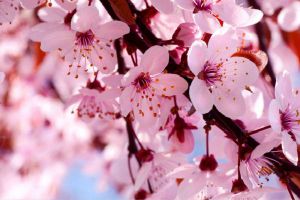
Cherry blossom, also known as mountain cherry, and also called fairy cherry blossom, Fukushima cherry, green-barked cherry, and thorn peach. It is a plant of the genus Cerasus, subgenus Cerasus, in the family Rosaceae.
Morphological characteristics of cherry blossoms
The bark of the cherry blossom is purplish-brown, smooth and glossy, with horizontal stripes. Flowers and leaves are alternate; the leaf blades are elliptical or obovate-elliptical, with awn-like teeth at the margins, pointed tips with glands, dark green and glossy on the surface, and slightly lighter on the underside. Stipules are lanceolate-linear, with finely cleft serrated margins, and glands at the cleft tips. Each inflorescence has three to five flowers, forming umbel-like flowers; sepals spread horizontally, and petal tips are notched, white, red, or pink. The flowers3open together with the leaves or after the leaves.
Growth habits of cherry blossoms
Cherry blossoms like sunlight and prefer a warm and humid climate environment. They are not strict about soil requirements, and grow best in deep, fertile sandy soil. The root system is shallow, and resistance to smoke, dust, harmful gases, and sea breeze is relatively weak. They are not tolerant of saline-alkali soil. The root system is relatively shallow, and waterlogged low-lying land should be avoided. They have a certain degree of cold resistance and drought resistance, but weak resistance to smoke and wind. Cherry blossom flowers are extremely beautiful. When in full bloom, the whole tree is lush and splendid, like clouds and rosy clouds. They are famous ornamental flowering trees that bloom in early spring.
Variety classification of cherry blossoms
Common types of cherry blossoms
1, Japanese cherry. The trunk bark is dark gray, leaves are elliptical, tips gradually pointed or tail-pointed, margins with awn-like fine pointed double serrations, tooth tips with glands, and the upper part of the petiole has2glands; stipules are linear, with glandular teeth; flowers are mostly double-petaled, white, pink, or rose red; drupe is spherical, about1cm in diameter, purplish-black when ripe. This species has two varieties: (1) Caixia Japanese cherry, double-petaled, large, rose red; (2) Pink Japanese cherry, double-petaled, medium-sized, pink.
2, Mountain cherry. Also known as green-barked cherry. Trunk bark is chestnut brown; leaves are mostly elliptical-lanceolate, tips often tail-like, margins with fine pointed single serrations or double serrations, tooth tips with glandular awns, leaf surface pale green and smooth, underside slightly white-powdered with hairs on the midvein, young leaves often brown. The petiole has2-4glands; flowers are single or double-petaled, white or pink; fruit is ovate-spherical, black when ripe. It may be a species native to China, and wild plants are commonly seen in the mountains of North China. It grows quickly, has strong sprouting ability, resists smoke and dust, and is often used as rootstock for cherries; the kernel can be used as medicine.
3, Cold cherry. The flowers are small, light red single-layered petals. If the climate is relatively warm,1it will bloom around mid-month, hence it is also called Atami cherry. It is presumed to be a hybrid of cold crimson cherry and mountain cherry.
4, Shuzenji cold cherry. The flowers are medium-sized, red-purple single-layered petals. It is a cherry blossom growing in the courtyard of Shuzenji Temple on the Izu Peninsula, and is presumed to be a hybrid of cold crimson cherry and Oshima cherry.
5, Cold crimson cherry. The flowers are small, deep red-purple single-layered petals. Wild cherry blossoms also grow in Taiwan, China, so it is also called Taiwan crimson cherry or crimson cold cherry. The flowers are bell-shaped and, when combined, present a special feeling.
6, Kawazu cherry. The flowers are medium-sized, red-purple single-layered petals. It is an early spring cherry blossom growing in Kawazu Town on the Izu Peninsula, and is presumed to be a hybrid of cold crimson cherry and Oshima cherry.
7, Oshima cherry. The flowers are large, white single-layered petals. It is a wild cherry blossom growing in places such as the Izu Seven Islands and the Boso Peninsula, and is very resilient to sea breeze. The cherry leaves used in sakura mochi are the leaves of this type of cherry blossom.
8, Daisy cherry. The flowers are small, like white chrysanthemum petals. It is a small cherry blossom of the Oding-character cherry lineage growing at Yahiko Shrine in Niigata Prefecture, with more than100kinds of petals, a precious and rare cherry blossom.
9, American cherry. The flowers are medium-sized, light red single-layered petals. This is a variety cultivated in the United States using the seeds of Somei Yoshino. Its original name was Akebono, but because Japan already had a cherry blossom with the same name, it was renamed to its current name.
10, Baigoji Juzu-kake cherry. The flowers are large, like light red chrysanthemum petals. It is a cherry blossom traditionally associated with Shinran Shonin. The cherry tree at Baigoji Temple in Kyose Village, Niigata Prefecture has been designated a national natural monument.
11, Great cold cherry. The flowers are medium-sized, light red single-layered petals. It is a cherry blossom growing in Angyo, Saitama Prefecture, also known as Angyo cold cherry. It is a beautiful cherry blossom that blooms about one week earlier than Somei Yoshino.
12, Kenrokuen chrysanthemum cherry. The flowers are large, like light red chrysanthemum petals. It is a cherry blossom growing in Kenrokuen in Kanazawa, with more than300petals.
13, October cherry. The flowers are medium-sized, light red multi-layered petals. It begins to bloom around10month, and will bloom again the following spring, flowering2times a year, a precious cherry blossom.
14, Nara double cherry. The flowers are medium-sized, light red multi-layered petals. It belongs to the Kasumi cherry lineage. The cherry tree growing at Chisoku-in in Nara City has been designated a national natural monument.
15, Edo higan. The flowers are small, light red single-layered petals. This type of cherry blossom has a very long lifespan. Jindai cherry of Takayama (Takekawa Village, Yamanashi Prefecture) and Usuzumi cherry of Neodani (Neo Village, Gifu Prefecture) are presumed to have lived for more than1,000years.
16, Winter cherry. The flowers are medium-sized, white single-layered petals. It is a cherry blossom that blooms twice a year (spring and autumn). A considerable number of this type of cherry blossom is planted in Sakura-yama Park in Onishi Town, Gunma Prefecture, among which "Miharu River winter cherry" is the most famous.
17, Eigenji. The flowers are large, white multi-layered petals. It is a cherry blossom growing in the courtyard of Eigenji Temple in Shiga Prefecture. It is a double cherry with very large white flowers.
18, Ichihara Toranoko. The flowers are medium-sized, light red multi-layered petals. It is a cherry blossom growing in Ichihara, Sakyo Ward, Kyoto City. Because the branches extend outward very long and the flowers also grow very densely like a tiger's tail, Otani Kozui named it Ichihara Toranoko.
19, Taibai. The flowers are large, white single-layered petals. It was a cherry blossom given to Japan by a British cherry blossom researcher in1932. It has already become extinct in Japan. Taibai was named by former Duke Takatsukasa Nobusuke.
20, Gyoiko. The flowers are medium-sized, green-yellow multi-layered petals. It has been widely known since ancient times and is a cherry blossom with a rare color.
21, Shogetsu. The flowers are large, light red multi-layered petals. It was formerly a cherry blossom growing on the Arakawa embankment in Tokyo, and is a very beautiful double cherry.
22, Imose. The flowers are large, red multi-layered petals. It is a cherry blossom located at Hirano Shrine in Kyoto. Because it has two pistils and also bears two fruits, it got this name.
23, Kanzan. The flowers are large, deep red multi-layered petals. It is a representative variety of double cherry and is also widely planted in Europe and America. In addition, the salted petals of this cherry blossom are also used in cherry blossom soup.
Common cultivated varieties of cherry blossoms
1.Cherry blossom, deciduous tree. About5~25m tall. Bark dark chestnut brown, smooth and glossy, with horizontal stripes. Branchlets hairless. Leaves ovate to ovate-elliptical, margins with awn-like semi-mature teeth, hairless on both sides. Corymbose or racemose inflorescence, flowers white or light pink. Diameter2.5~4cm, flowering period4month to5month. Drupe spherical, black,7month fruit ripens.
2.Japanese late cherry, about10mtall, bark light gray. Leaves obovate, margins with long awn-like teeth; flowers single or double-petaled, drooping, pink or nearly white, fragrant,2~5flowers clustered, flowering period4month.
3.Japanese early cherry, a small tree, about5mtall, bark with horizontal stripes, old bark braided. Branchlets brown, leaves obovate to ovate-lanceolate. Flowers pink, diameter2~2.5cm,2~5flowers in umbel inflorescence, blooming before leaves in spring.
4.Oyama cherry,12~20mtall, bark brown, branchlets purplish-brown, leaves elliptical-ovate. Flowers pink,2~4flowers clustered, diameter3~5cm, flowering period3~4month.
5.Yunnan cherry, about10mtall, bark brown, branchlets purplish-brown, leaves elliptical-ovate or obovate, margins with double teeth. Flowers pink to deep red,2~5flowers clustered, flowering period2~3month.
6.Ke cherry, about25mtall, bark light brown, branchlets green, leaves long elliptical to lanceolate, flowers pink, flowering period1month to the following year1month.
7.Mountain cherry: mostly wild, flowers small, single-petaled, white or pink, pedicels and calyx hairless.
8.Hairy cherry: basically the same appearance as mountain cherry, but its leaves, petioles, and calyx all have hairs.
9.Double white cherry: flowers white, double-petaled, a main cultivated variety.
10.Double red cherry: flowers pink, double-petaled.
11.Red-white cherry: flowers light red, double-petaled.
12.Gorgeous cherry: flowers light red, straight-petaled, flowers large and pedicels long.
13.Weeping cherry: flowers pink, double-petaled, flowering branches spread open and droop.
Cherry blossom flower language
Cherry blossom flower language - life. According to legend, cherry blossoms were once only white, and brave samurai chose to disembowel themselves under the cherry tree they loved. Because when a samurai believed he had reached the glory of life, he would choose to end his own life. Therefore, blood flowed like a river under the cherry trees, and from then on the cherry blossoms bloomed red... The redder the cherry blossom petals, the more souls of the dead there were under the tree, and the more it embodied the "Japanese spirit."
Cherry blossom flower language - passionate, pure, noble. The life of a cherry blossom is very short. In Japan there is a folk saying: "cherry blossom7days," which means that from opening to withering, a single cherry blossom takes about7days, and the whole cherry tree from blooming to fully withering takes about16days, forming the characteristic of cherry blossoms blooming while falling. It is precisely this characteristic that gives cherry blossoms such great charm. They are revered as the national flower not only because of their charm and beauty, but more importantly because of the "heroic sacrifice" of withering immediately after a brief splendor. Japanese people believe that life is short, and while alive one should be as splendid, pure, and beautiful as cherry blossoms; even in death, one should leave decisively. When cherry blossoms fall, they are unstained and unsoiled, very crisp and neat, and are revered as a symbol of the Japanese spirit.
Different cherry blossoms also represent different meanings.
Cherry blossom flower language: life, happiness for a lifetime without ever giving up, loving only you for a lifetime, the law of fate is circulation,waiting for you to return.
Mountain cherry: smiling at you, beauty of spirit.
Western cherry: education in goodness.
Winter cherry: Eastern mystery.
Double cherry: quiet/pure.
Cherry herb: youth/besides you, no other love.
Mountain cherry: pure/noble/indifferent.