How do you grow plumeria? This kind of environment helps it grow better
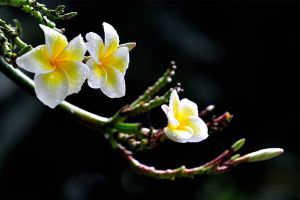
Other names for plumeria
Burmese gardenia, egg-yolk flower, Indian jasmine, dajihua.
Growth habits of plumeria
Plumeria is a sun-loving plant and prefers a warm, humid environment with plenty of sunlight. Although it can also grow in semi-shade, its branches tend to grow leggy, resulting in fewer or even no flowers. In a damp, shady environment, many aerial roots grow on the branches, which looks rather ugly.
Plumeria grows best in deep, fertile, well-aerated, acidic soil rich in organic matter, so that the plant can be robust, with abundant flowers and vivid colors. In poor soil, plumeria grows poorly, with small flowers and dull colors.
Plumeria has poor cold tolerance. Its most suitable growing temperature is 20-26°C, and the overwintering temperature must not be lower than 8°C, otherwise it will suffer cold damage. In the vast number of towns south of the Tropic of Cancer in China, it can overwinter outdoors. In Central China and North China, potted plants must be brought indoors to overwinter in winter.
Uses of plumeria
1. Ornamental value: Plumeria is deeply loved by people in many regions and countries. In Laos, plumeria is designated as the national flower and is highly revered; in the tropical tourist destination Hawaii, people like to string the picked plumeria flowers into garlands as wearable decorations, so plumeria is also a symbol of Hawaiian festivals. The plumeria tree has a beautiful shape, with many branches on the stem, oddly shaped and in countless forms; the leaves resemble loquat leaves, and after they fall in winter, semicircular leaf scars remain on the branches, much like deer antlers adorned with beautiful spots, making it the top choice small tree for landscaping, courtyard arrangement, and potted ornamental display in tropical regions.
2. Medicinal value: The flowers of plumeria can be used as medicine, with effects of clearing heat and relieving summer heat, clearing the intestines and stopping diarrhea, and relieving cough and reducing phlegm, used to treat heatstroke, dysentery, abdominal pain, and cough. The bark is thin and grayish-green, rich in toxic white sap, and can be used for external application to treat scabies, redness and swelling, and other conditions.
3. Plumeria tea: The fresh flowers can be dried in the sun for brewing tea, commonly known as plumeria tea. Plumeria is one of the five flowers in Guangdong's famous herbal tea, Five-Flower Tea. It is cool in nature, sweet and mild in taste; it enters the large intestine and stomach meridians, and has the effects of moistening the lungs and detoxifying, clearing heat and removing dampness, and lubricating the intestines.
4. Other uses: Besides white, plumeria also comes in red and yellow, and both can be used to extract essence for making high-grade cosmetics, soap, and food additives, with quite high prices and great commercial development potential; they also have the effects of treating heat dysentery, moistening the lungs, and detoxifying. The wood is white, light and soft, and can be used to make musical instruments, tableware, or furniture.
The flower language of plumeria
Nurturing hope, resurrection, new life.
Plumeria blooms from May to October each year. Although it has no mysterious legends, no elegant temperament, and no noble posture, it has a simple appearance. It is precisely this simplicity that makes people feel even more full of hope.