What are the characteristics of the Japanese aralia? A complete guide
Other names for the Japanese aralia
Eight Golden Plates, Eight Hands, Hand Tree, Jingangzu.
Morphological characteristics of the Japanese aralia
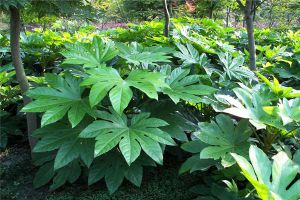
The Japanese aralia is an evergreen shrub or small tree, reaching up to 5 m in height. Its foliage is glossy and green all year round, with leaves shaped like green palms. It is shade-tolerant, often planted beside rockeries or large trees in gardens, and can also be used as a foliage plant indoors, in halls and at conference venues.
Growing habits of the Japanese aralia
The Japanese aralia is a subtropical tree species that prefers shady, humid and warm climates. It is not tolerant of drought or severe cold. In the Nanjing-Shanghai area, it should be planted in spots with a favorable microclimate, ideally in well-drained, fertile, slightly acidic soil, though it also adapts to neutral soil. Its ability to send up suckers is fairly strong.
Cultivar classification of the Japanese aralia
(1) White-spotted Japanese aralia, with white spots on the leaf surface;
(2) Yellow-spotted Japanese aralia, with yellow spots on the leaf surface;
(3) Yellow-veined Japanese aralia, with fine yellow lines on the leaves;
(4) Deep-lobed Japanese aralia, with palmate leaves deeply lobed, and each lobe further divided;
(5) White-edged Japanese aralia, with white leaf margins;
(6) Wavy-leaved Japanese aralia, with wavy, crinkled leaf margins;
(7) Dwarf Japanese aralia, a short plant with dense branches and leaves and vigorous growth.
The value of the Japanese aralia
Medicinal value: The leaves, roots and bark of the Japanese aralia can be used medicinally. It has the effects of promoting blood circulation and removing blood stasis, resolving phlegm and relieving cough, dispelling wind and dampness, and removing blood stasis to relieve pain. It is mainly used for traumatic injuries, cough with copious phlegm, rheumatic arthralgia and gout.
Ornamental value: The Japanese aralia stays evergreen all year round and has large leaves. Its leaf shape is elegant, deep green and glossy, making it a highly popular indoor foliage plant. It adapts to low-light indoor environments and is a commonly used plant material for beautifying hotels, restaurants, office buildings and homes. It is used to decorate entrance halls, windowsills, corridors and pond edges, or as a base planting for indoor flower beds.
Air purification: The Japanese aralia has a very strong air-purifying effect and absorbs harmful gases such as formaldehyde and benzene very well. After renovating a new home, you can place a pot of Japanese aralia, and its air-purifying effect is very good.
The flower language of the Japanese aralia
The flower language of the Japanese aralia is: wealth from all directions, gathering the vitality of the four quarters, and rising to a higher level. It is very suitable for placing at home, has the effect of bringing wealth, and is also suitable for use as a gift, much loved by people.