What are the characteristics of the Chinese lantern hibiscus? A complete guide
Other names for the Chinese lantern hibiscus
The Chinese lantern hibiscus is also called split-petal hibiscus, coral hibiscus, windbell hibiscus, lantern flower, Chinese lantern flower, and false Safflower.
Origin of the Chinese lantern hibiscus
The Chinese lantern hibiscus is native to tropical East Africa and is a common ornamental garden plant in tropical countries. It is also cultivated in Taiwan, China, Fujian, Guangdong, Guangxi and Yunnan.
Morphological characteristics of the Chinese lantern hibiscus
The Chinese lantern hibiscus is an evergreen upright shrub about 3 m tall. Its branches are rather slender and often droop, with a relatively smooth surface and no downy hairs.
The leaves of the Chinese lantern hibiscus are oval or oblong, about 4-7 cm long and 1.5-4 cm wide, with a short pointed tip and a blunt or broadly wedge-shaped base. The leaf margins are toothed and jagged, and both sides of the leaf are hairless.
The leaf stalk of the Chinese lantern hibiscus is 1-2 cm long and bears downy hairs. The stipules are awl-shaped, about 2 mm long, and usually fall early.
The flowers of the Chinese lantern hibiscus are borne singly in the leaf axils at the ends of the branches. The flower stalk is rather slender and droops downward, about 8-14 cm long, smooth and hairless. The flower bud has 5 parts, very small, lance-shaped, 1-2 mm long. The calyx is tubular, about 1.5 cm long, densely covered with fine hairs, and often splits open on one side.
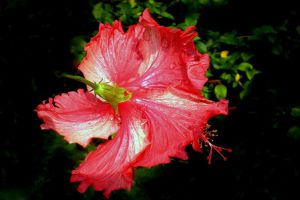
The flower of the Chinese lantern hibiscus has 5 petals, red, about 5 cm long, deeply and finely split into a fringed form and curved back upward. The staminal column is long and rather prominent, drooping, about 10 cm long, hairless. The flowering period is year-round.
The capsule is long and cylindrical, about 4 cm long and about 1 cm in diameter.
Main value of the Chinese lantern hibiscus
The Chinese lantern hibiscus is an ornamental flowering shrub with relatively large flowers, rather bright colors and a long flowering period.
In the south, the Chinese lantern hibiscus is often planted beside ponds, in front of courtyards, along roadsides and by walls, blooming continuously all year round and looking very festive.
In the Yangtze River basin and northern regions, the Chinese lantern hibiscus is grown on balconies or in courtyards. Under conditions of ample light, its ornamental period is also extended, so it is one of the main potted plants displayed in public places in summer and autumn.