What are the other names for Buddhist pine? An introduction to its common names
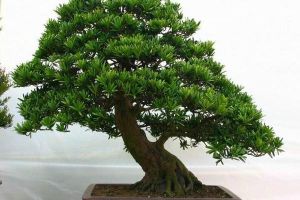
Other names for Buddhist pine
Luohan pine, evergreen Luohan pine, Tu pine, money pine, immortal cypress, Luohan
Morphological characteristics of Buddhist pine
Buddhist pine (the original variety) is a tree up to 20 m tall with a trunk diameter at breast height of up to 60 cm; the bark is gray or grayish brown, shallowly longitudinally fissured, and flakes off in thin plates; the branches spread out or slope upward and are fairly dense.
The leaves are spirally arranged, linear-lanceolate, slightly curved, 7-12 cm long and 7-10 mm wide, with a pointed apex and a wedge-shaped base; the upper surface is dark green and glossy with a markedly raised midrib, while the lower surface is whitish, grayish green or pale green with a slightly raised midrib.
Growth habits of Buddhist pine
It prefers a warm, humid climate and has weak cold tolerance, so in North China it is grown in pots for ornamental purposes; it is strongly shade-tolerant; it prefers moist sandy loam with good drainage and is highly adaptable to soil, able to survive even on saline-alkali soil; it is fairly resistant to a variety of polluting gases such as sulfur dioxide, hydrogen sulfide and nitrogen oxides; and it has strong resistance to pests and diseases.
It is produced in Jiangsu, Zhejiang, Fujian, Anhui, Jiangxi, Hunan, Sichuan, Yunnan, Guizhou, Guangxi, Guangdong and other provinces and regions, and is cultivated in courtyards as an ornamental tree.
Main values of Buddhist pine
Ornamental: Because the Buddhist pine has an elegantly antique tree form and a curious combination of seed and seed stalk, it is much loved, and it is widely planted in temples and residential courtyards in the south. It can be planted in pairs in front of a gate, as a solitary specimen in a central courtyard, or in a corner by a wall together with rockery and lake stones. Variegated-leaf Buddhist pine can be planted in flower terraces, or used in flower beds or grown in pots for indoor appreciation. Small-leaf Buddhist pine can also be planted as a courtyard hedge.
Medicinal: The sap, roots, bark and leaves of the Buddhist pine can all be used as medicine; they can stop bleeding, relieve pain and relieve cough, among other effects, making it a very good medicinal material.
Economic: The wood is fine and even in texture and easy to work. It can be used for furniture, utensils, stationery and farm tools.