What are the alternative names of Lantana camara? A full analysis of its common aliases
Alternative names of Lantana camara
Shanda dan, Ruyi cao, Wucai hua, Wulei dan, Wuse xiuqiu, Bianse cao, Dahong xiuqiu
Growing habits of Lantana camara
It likes light and prefers a warm, humid climate. It has strong adaptability and tolerates drought and poor, thin soil, but it is not cold-hardy, and grows better in loose, fertile, well-drained sandy loam. Its flowering period is from June to October. It naturally prefers warm, humid, sunny locations. It tolerates drought, tolerates slight shade, and is not cold-hardy. In the south it is basically grown in the open ground, while in the north it can be kept in pots for ornamental display. It is not strict about soil quality, and grows best in fertile, loose sandy soil.
This species is a tropical plant that likes high temperatures and high humidity, also tolerates dry heat, and has poor cold resistance. Keep the temperature above 10°C and its leaves will not drop. It cannot tolerate ice and snow, has fairly strong adaptability to soil, tolerates drought and waterlogging, and is not demanding about fertility.
Morphological characteristics of Lantana camara
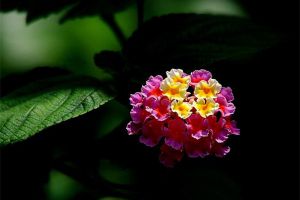
Lantana camara is an evergreen shrub, 1-2 m tall, and sometimes its branches grow in a vine-like manner. The stems and branches are square in shape, have short fine hairs, and usually bear short, hooked thorns. The leaves are simple and opposite, ovate or ovate-oblong, with acuminate tips and rounded bases, rough and hairy on both sides, and giving off a strong odor when crushed. The flower heads are axillary on the upper part of the branch tips, with more than 20 flowers per inflorescence; the corolla tube is slender, and the apex is mostly five-lobed, resembling a plum blossom. The corolla color is variable: yellow, orange-yellow, pink, and deep red. The flowering period is relatively long; when planted in the open ground in the south, it flowers almost all year round, while in Beijing, potted plants have the greatest flower quantity in July and August. The fruit is a round berry, purple-black when ripe. The genus has 150 species, of which 2 have been introduced and cultivated in China, along with several horticultural varieties. Trailing lantana is semi-vine-like, with rose-red flowers tinged with blue-purple. White lantana is mainly white-flowered. Yellow lantana is mainly yellow-flowered.
Main value of Lantana camara
Ornamental: Lantana camara has beautiful flower colors and a long viewing period for its blooms; with green trees and abundant flowers, it stays colorful all year round and has strong resistance to dust and pollution. In South China it can be planted in parks and courtyards as flower hedges or flower clusters, and can also form green ground-cover vegetation along roadsides and in open fields. Potted plants can be placed at doorways, in halls, in living rooms, and other places for viewing, and can also be arranged into flower beds.
Medicinal: For collection and processing, the root or the whole plant is used as medicine. It can be collected throughout the year, and used dried or fresh. Nature and flavor: root: bland, cool. Branches and leaves: bitter, cool, with a foul odor. Slightly toxic. Flowers: sweet, bland, cool. Effects: root: clear heat and remove toxin, dissipate nodules and relieve pain. Branches and leaves: dispel wind and relieve itching, remove toxin and reduce swelling.
The flower language of Lantana camara
Cheerful, lively