Kerria japonica: you may not know it has these other names
The family and genus of Kerria japonica
Kerria japonica is a shrub in the genus Kerria, subfamily Rosoideae, and is a woody plant.
Other names for Kerria japonica
Kerria japonica is also called Di Tang, Feng Tang Hua, Huang Du Mei, Jin Di Tang Mei, and Huang Yu Mei.
The origin of Kerria japonica
It is native to China from North China to South China, and is distributed in Anhui, Zhejiang, Jiangxi, Fujian, Henan, Hunan, Hubei, Guangdong, Gansu, Shaanxi, Sichuan, Yunnan, Guizhou, Beijing, Tianjin and other provinces.
The morphological characteristics of Kerria japonica
Kerria japonica grows 1-2 m tall; the branchlets are green, cylindrical, and hairless.
The leaves are alternate, triangular-ovate or ovate, with a long acuminate tip and a rounded base; the petiole is 5-10 mm long and hairless.
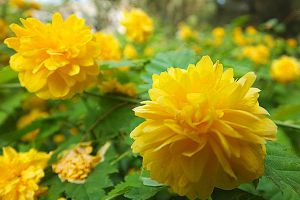
The flowers are solitary, borne at the tips of the current year's lateral branches, with hairless pedicels; the flowers are 2.5-6 cm in diameter; the sepals are ovate-elliptic, acute at the tip, with a small mucro, entire, hairless, and persistent in fruit; the petals are yellow, broadly elliptic, with a concave tip, and are 1-4 times longer than the sepals.
The achene is obovate to hemispherical, brown or dark brown, hairless, and wrinkled.
Kerria japonica blooms from April to June, and fruits from June to August.