What are the characteristics of the purple-leaf sand cherry? A complete guide
Morphological characteristics of the purple-leaf sand cherry
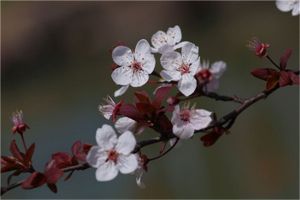
The purple-leaf sand cherry grows 1.8 m to 2.5 m tall with a crown spread of 1.5 m to 2.8 m. The young branches are purplish brown, and the old branches have lenticels. The flowers are solitary, pale pink, with 5 petals and a faint fragrance, blooming from April to May.
The purple-leaf sand cherry is a hybrid of the purple-leaf plum and the dwarf cherry. It is cultivated everywhere, and is suitable for cultivation in North China, Central China, East China and South China; in Northeast China, in Liaoning and southern Jilin, it can overwinter safely in winter.
The purple-leaf sand cherry has a good color effect. Throughout the entire growing season its leaves are purplish red, bright and distinctive, with a compact tree form and dense foliage, giving the whole plant a fine color display. For pot cultivation, it can be made into medium and miniature bonsai.
How to grow the purple-leaf sand cherry
Sunlight
The purple-leaf sand cherry is a light-loving tree species, but it is also cold-tolerant and shade-tolerant. Grown in insufficient light, its leaf color turns green, so it should be planted in a spot with ample sunlight.
Soil
The purple-leaf sand cherry is not strict about soil, but it grows best in fertile, deep, well-drained neutral or slightly acidic sandy loam; light clay is also acceptable. For pot cultivation, the pot should be rather deep and large, and broken tiles or broken hard plastic foam blocks should be placed at the bottom of the pot to enhance the soil's air permeability and drainage capacity and to prevent root rot.
Water
The purple-leaf sand cherry likes a moist environment and dislikes waterlogging, so it should be planted in a high, dry spot. It is best to keep the soil moist without standing water.
Ornamental value of the purple-leaf sand cherry
The purple-leaf sand cherry has a good ornamental effect, grows fast, propagates easily, tolerates pruning and has strong adaptability. It is generally propagated by grafting and cuttings; the rootstock for grafting is usually wild apricot or wild peach, with apricot rootstock being the best. It has strong suckering ability, so in garden cultivation it is easy to train into a ball or a hedge; by pinching the tips several times it forms many branches, and before winter the stray branches are cut away and the leggy branches are heavily shortened, making it suitable for cultivation and ornament.
In landscaping, because of its strong branch sprouting ability and bright leaf color, and because it is purplish red from bud break to leaf fall, the purple-leaf sand cherry can be planted as a whole for urban colored hedges or color blocks, or planted on its own; it is one of the best tree species for greening and beautifying cities.