It turns out that ye lai xiang (night-blooming jasmine) also has other flower names. What are its aliases?
The growing habits of ye lai xiang:
Ye lai xiang mostly grows in woodland or among shrubs. It likes warm, humid, sunny, well-ventilated environments with loose, fertile soil; it is drought-tolerant and tolerant of poor soil, but not of waterlogging or cold, and growth stops after leaf drop in winter. After the weather warms in spring it puts out branches and leaves, with an axillary bud or flower bud at each node; as it grows it continually produces lateral branches and sends out inflorescences, generally blooming successively from May to October, fragrant when in flower and even more strongly scented at night. It sets fruit in winter.
The morphological characteristics of ye lai xiang:
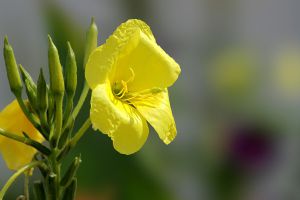
The branchlets of ye lai xiang are weak, hairy and contain milky sap. Leaves are opposite; the blades are broadly ovate, cordate to oblong-ovate, 4-9.5 cm long and 3-8 cm wide, with a short acuminate apex and a deeply cordate base, entire margins, 7-9 palmate veins arising from the base, and hairs on the margins and veins. The umbel-like cymes are axillary and may bear up to 30 flowers; the corolla has 5 lobes, oblong, yellow-green, with a fresh fragrance that is even stronger at night, hence the names "ye lai xiang" and "ye xiang hua"; the corona has 5 lobes, fleshy, shorter than the anthers, borne on the gynostegium, with an acuminate tip; there is 1 pollinium per locule, elliptical, erect. The follicles are lanceolate, 7.5 cm long, with a thick exocarp and no hairs. The seeds are broadly ovate, about 8 mm long, with white silky hairs at the apex.
The flower language of ye lai xiang:
The flower language of ye lai xiang is a pure heart, happiness, beauty, independence and rebellion.
Flower divination: You radiate a modern air, love adventurous and exciting things, and enjoy the spotlight, hoping to be the focus of others' attention. You are good at showing your best side and actively covering up your shortcomings; in love you act on impulse and forget all about it afterwards.
The variety classification of ye lai xiang:
The genus to which tuberose (Polianthes tuberosa) belongs has 12 species, but only tuberose is cultivated and used, and there are not many varieties, mainly the following:
(1) Albino: a single-flowered variety formed by bud sport, with pure white flowers;
(2) Dwarf pearl: a dwarf variety;
(3) Var. flore-pleno Hort: a double-flowered variety;
(4) Mexican early bloomi: single-flowered, an early variety, blooming year-round, most profusely in autumn;
(5) Pearl: a double-flowered variety, with stems 75 cm-80 cm tall, short inflorescences, many densely packed flowers and a short corolla tube;
(6) Tall double: a large-flowered double variety with long flower stems;
(7) Variegale: leaves long and curved, with golden-yellow stripes
The uses of ye lai xiang:
Ye lai xiang is mainly cultivated for ornamental purposes. Its branches are slender, and it blooms in summer and autumn; the yellow-green flowers open in the evening and give off a strong, sweet fragrance. In the south it is often used to landscape courtyards, areas by windows, pond edges and pavilion sides. It is also a semi-wild vegetable whose fresh flowers and flower buds are eaten. It has the effect of clearing the liver and brightening the eyes, and can treat red, swollen and painful eyes, measles affecting the eyes, corneal opacities and so on.