What is the common name of the coral cactus? This article will help you understand it clearly
Morphological characteristics of the coral cactus
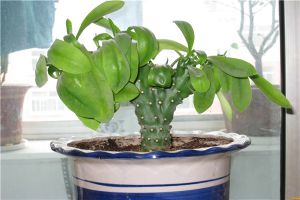
The coral cactus prefers full sunlight but is also tolerant of partial shade, and it will not die from slight drought, making it suitable for household potted display. Many people believe this is a type of primitive cactus plant with leaves, which is incorrect. This plant is a cristate (or monstrose) variant of Euphorbia neriifolia, a succulent in the Euphorbiaceae family. This can easily be judged from the absence of the areoles characteristic of cacti at the base of its spines and the presence of white milky sap in the plant.
It has emerald green and beautiful leaves, both stems and leaves are fleshy, and the plant shape is elegant, closely resembling the qilin from ancient Chinese legends, hence the name coral cactus. The fleshy metamorphosed stem is in an irregular palmate fan shape, green when young, turning yellow-brown and woody when old, with fleshy leaves densely growing at the top and edges of the metamorphosed stem.
Growth habits of the coral cactus
The coral cactus prefers warmth, requires full sunlight, and is suitable for well-drained sandy loam soil. It is drought-tolerant, not cold-tolerant, but also tolerant of partial shade, making it suitable for household potted display. It can be planted in courtyards in warm regions, while in cold regions it is mostly grown in pots for display.
Precautions for cultivating the coral cactus
The white milky sap in the stem of the coral cactus is toxic, especially to the eyes, so when cultivating it at home, care should be taken to prevent children from accidentally getting the stem sap into their mouths or eyes.
Propagation methods of the coral cactus
The coral cactus is generally propagated by cuttings, and cuttings can be taken anytime from April to October. For cutting time, it is best to choose a sunny morning. Cut a piece of robust metamorphosed stem, let it dry in a cool place for 3-4 days, and after the wound has dried and shrunk, insert it about 2-3 cm into clean river sand. Do not water at first; after 2 days, spray water to keep the potting soil moist. Roots will form in about one month, then it can be transplanted into a pot. When cutting the metamorphosed stem piece, white milky sap tends to flow out; let it drain completely or rinse it away with water, because if the sap dries it easily forms a rubbery gel that seals the cut and affects root formation. After cutting, place it in a shaded area for care. Keep it moist, but the cut should not be waterlogged, as waterlogging will rot the cutting.
Pest and disease control of the coral cactus
The coral cactus has few pests and diseases, but if kept long-term in a greenhouse or in a poorly ventilated location, it is susceptible to scale insect damage. In winter and spring, spray and wash the leaves with clean water once every 10 days to remove dust. In addition, it is very sensitive to coal gas, and exposure to it easily causes leaf drop (it can be used for indoor coal gas leak detection).