Purple magnolia grows more advantageously in such environments
Purple Magnolia Tips
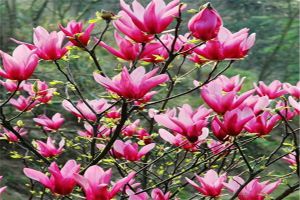
Purple magnolia is a deciduous shrub of the family Magnoliaceae and genus Magnolia, reaching 3 to 5 m tall when planted in the ground and 1 to 1.5 m tall in pots, often growing in clumps, with obovate or elliptic leaves, and flowers borne singly at the tips of branches, bell-shaped, with 9 tepals arranged 3 per whorl, purple or purplish red, flowering in spring before the leaves emerge or at the same time as the leaves.
Growth Habits of Purple Magnolia
Purple magnolia prefers a warm, humid environment with plenty of sunlight; it is relatively cold-hardy but not tolerant of drought or saline-alkaline conditions, fears waterlogging, and requires fertile, well-drained sandy loam. Purple magnolia cannot grow in calcareous or chalky soils; its branches are weak, so it needs to be planted in a slightly shaded spot; it has good wind resistance and is also highly tolerant of air pollution; purple magnolia has a well-developed root system and strong suckering and sprouting ability, and tolerates pruning and shaping, but its healing ability is poor, so after pruning sulfur powder should be applied to prevent rot; its fleshy roots are easily damaged, so it is not easy to transplant, and if transplanting is needed it should be done in mild, humid weather in late autumn after leaf fall or in late spring after flowering. Purple magnolia needs frequent pruning and shaping, promptly removing diseased, damaged and dead branches, otherwise the tree shape will develop into a shrub form, which is also unfavorable for the growth of flower buds.
Purple Magnolia Blooming
Purple magnolia originates from central China and has long been cultivated for ornamental purposes; it was a precious ornamental flower of palace gardens in Jiangnan in the past, with a cultivation history of more than 2,500 years. Purple magnolia blooms every year in early spring, with flowers opening before the leaves or rarely at the same time as the leaves; although traces of winter still remain on the leafless branches, the branch tips are covered with graceful and luxurious purple flowers. Each blossom stands elegantly, seeming as if carved from powder and jade, elegant and graceful, vying in beauty. The scent is fragrant, and the corolla is large, purple or purplish red, large and bell-shaped, with elegance showing through the purple, very delicate and charming, with an alluring fragrance. The flowers bloom for about one month, creating a magnificent sight. If white magnolia is like a noble princess, then purple magnolia is like a fashionable woman.
The Uses of Purple Magnolia
The flower buds of purple magnolia can be used as medicine, and the flowers can be used to extract natural essence for making cosmetics. About 3 m tall, with flowers and leaves opening at the same time; in the Summer Palace in Beijing, there are purple magnolias over a hundred years old. This species is produced in Hubei, Sichuan, Yunnan and other provinces. The flower buds of purple magnolia are used as medicine, and propagation is mostly by division; its other habits and uses are the same as those of white magnolia.