What are the other names for Exochorda racemosa? Let us introduce you to this plant
Exochorda racemosa family and genus
Rosaceae, Exochorda
Exochorda racemosa other names
Cocoon flower, Jiuhuotou, golden melon fruit; Latin scientific name: Exochorda racemosa
Exochorda racemosa origin
Exochorda racemosa originates from the Jiangsu and Zhejiang area of China, and is currently distributed in both North China and Central China.
Exochorda racemosa growth habits
Exochorda racemosa prefers a warm and humid climate. It likes light but also tolerates shade, and has strong cold resistance; it is not demanding about soil, and can grow in acidic soil, neutral soil, and poor soil. Of course, it grows more vigorously and has stronger sprouting ability in fertile, well-aerated soil.
Exochorda racemosa morphological characteristics
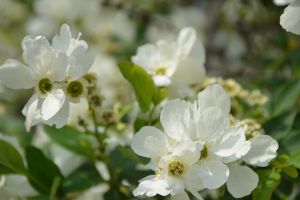
Exochorda racemosa is a deciduous shrub, but it often takes the form of a small tree. The plant can reach up to 5 m tall. Its branches are hairless and angular, red-brown when young. The leaves are oblong-elliptic or obovate, with rounded blunt tips, alternate and simple, with short petioles, and the leaf underside is grayish-white; the flowers of Exochorda racemosa are bisexual, with obovate petals about 1.5 cm long, slightly blunt at the tip, and a bell-shaped calyx tube.
Common varieties of Exochorda racemosa
Red-stalked Exochorda racemosa: this type has longer petioles, about 2 cm, and they are red, hence the name; the flower stalks are extremely short, almost stalkless.
Serrate-leaved Exochorda racemosa: its main characteristic is that the upper middle part of the leaf has sharp serrations, and the young parts are slightly covered with soft hairs.