What is Viburnum farreri? A botanical introduction to help you understand it
Viburnum farreri, also known as fragrant viburnum, is a deciduous shrub in the genus Viburnum. It blooms in early spring each year, sending out a refreshing fragrance in the soft spring breeze. Come and take a look with us at this flower that brings fragrance with the warmth of spring!
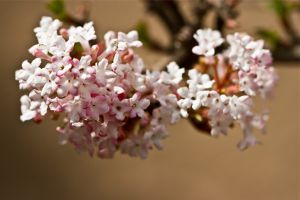
Family and genus of Viburnum farreri
Caprifoliaceae, genus Viburnum
Distribution of Viburnum farreri
Viburnum farreri is mainly distributed in temperate regions, and in China it is found in areas such as North China and Northwest China.
Morphological characteristics of Viburnum farreri
Viburnum farreri is a deciduous shrub that can reach up to 5 m tall; branches grown in the current year are green, turning reddish-brown in the second year, and as time goes on they become grayish-brown or grayish-white; the leaves of Viburnum farreri are elliptical with a papery texture, the leaf tip is sharply pointed, the leaf base is wedge-shaped, the leaf margin has triangular serrations, and there are fine hairs on the veins. Each leaf has 5-7 pairs of lateral veins, and the lateral veins reach all the way to the tips of the teeth; Viburnum farreri has a panicle inflorescence, borne at the top of short shoots on young leaves, about 3-5 cm long. One of its more notable features is that it flowers before producing leaves. The flowers of Viburnum farreri are salverform, with a flower diameter of about 1 cm. The flowers are fragrant, the filaments are very short, and the anthers are slightly yellowish-white and nearly round; the stigma is 3-lobed and lower than the calyx teeth. The flowering period of Viburnum farreri is April-May; the fruit of Viburnum farreri is oblong and purplish-red, about 8-10 mm long and about 6 mm in diameter; the stone is relatively flat and has 1 obvious deep ventral groove.
Growth habits of Viburnum farreri
Viburnum farreri prefers fertile, loose, well-drained slightly acidic soil and is not tolerant of poor soil; Viburnum farreri is not drought-tolerant and prefers moist soil, but grows poorly in waterlogged places, so be careful to drain promptly; Viburnum farreri likes light but is not tolerant of harsh sun exposure, and can also grow under semi-shade conditions. Intercropping with larger trees is beneficial to its growth; Viburnum farreri does not have high temperature requirements and can overwinter in the open ground in warm microenvironments in the north.
Application value of Viburnum farreri
Viburnum farreri has a particularly early flowering period, blooming in early spring, with white flowers and a strong fragrance. The plant has dense branches and leaves and an elegant leaf shape, so it can be used to decorate courtyards and can also be planted beside lawns and under tree shade.
The flower language of Viburnum farreri
Unchanging love until death