What are the characteristics of the dawn redwood? A guide to the features of the dawn redwood
Alternative names for the dawn redwood
Shuisuo tree, scientific name:Metasequoia glyptostroboides Hu & W. C. Cheng
Dawn redwood family and genus
Gymnosperm, family Taxodiaceae, genus Metasequoia.
Geographical distribution of the dawn redwood
The dawn redwood can be cultivated in areas south of Beijing, and grows best at the junction of Hubei, Chongqing and Hunan provinces, with a vertical distribution generally at an altitude of750~1500m.
Morphological characteristics of the dawn redwood
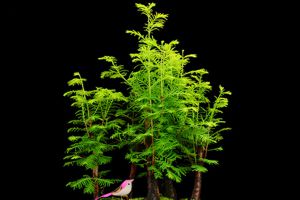
The dawn redwood is a deciduous tree that can reach a height of35m, with a diameter of up to2.5m, and opposite branchlets. The leaves are linear, decussately opposite, forming pinnate compound leaves; the upper surface of the leaf is pale green, the lower surface is lighter in color, with two pale yellow stomatal bands along the midrib with4-8bands. The bark of the dawn redwood is grayish brown; young bark splits into thin flakes and peels off, while mature bark splits into long strips and peels off; the dawn redwood is monoecious. The cones hang down, nearly spherical, slightly with4ridges, and have long stalks; the seed scales are woody and shield-shaped, and the seeds are flat with narrow wings around them. The flowering period of the dawn redwood is in2late month, and the cones mature in11month.
Growing environment of the dawn redwood
The dawn redwood prefers warm and humid climatic conditions, and mostly grows in places with gentle terrain, deep soil layers, and moist or slightly waterlogged conditions; acidic mountain yellow soil, purple soil or alluvial soil are suitable for its growth; the optimal growth temperature for the dawn redwood is around18°C, and it can grow in summers that are cool and winters that have snow but are not severely cold; the dawn redwood is light-loving, intolerant of barren and dry conditions, and its growth rate is often governed by soil moisture; it transplants easily and survives, and in places with long-term waterlogging the plant grows slowly, with the base of the trunk usually swollen and having longitudinal ridges.