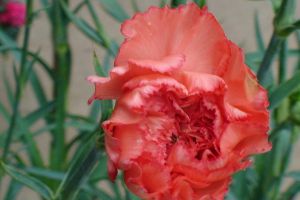
Carnations are so unique and beautiful like this - will you like them?
Alternative names for carnation
Carnation, also known as lion's head pink, musk pink, fragrant pink, large-flowered pink, and Dutch pink, is a plant in the family Caryophyllaceae and the genus Dianthus.
Morphological characteristics of carnation
Carnation is an evergreen subshrub, cultivated as a perennial herbaceous perennial flower. Because the petals have fringed edges and a fragrant scent, it is widely cultivated. It is generally divided into two types: flowerbed carnations and florist carnations; the stems are clustered, hard in texture, gray-green, with swollen nodes, and a height of about50cm, with thick linear, opposite leaves. The stems and leaves are similar to those of China pink but thicker and sturdier, covered with a white powdery bloom. The flowers are large, fragrant, solitary,2-3clustered in twos or in cymes; below the calyx are four rhombic-ovate small bracts, with short pointed tips, about one quarter the length of the calyx tube; the calyx tube is green, five-cleft; the petals are irregular, with toothed edges, single or double, in colors such as red, pink, yellow, and white. The flowering period is4month to9month, and under protected cultivation it flowers all year round.
Growth habits of carnation
Carnation prefers a cool and dry ecological environment with ample sunlight and good ventilation. It has good cold tolerance and poor heat tolerance. The optimum growth temperature is14--21°C. When the temperature exceeds27°C or falls below14°C, the plant grows slowly. It is suitable for planting in calcareous soil rich in humus and with good drainage. It likes fertilizer.
Variety classification of carnation
There are extremely many carnation varieties, with plant characteristics, flower forms, and flower colors varying endlessly, and classification methods also differ.
By flowering habit: once-blooming type, and year-round blooming type.
By flower size: large-flowered type, and small-flowered type.
By cultivation method: open-field cultivation type (single-season flowering), and greenhouse cultivation type (can bloom continuously).
By cut-flower pruning method: standard type (large-flowered type, one flower per stem), and spray type (small-flowered type, multiple flowers per stem).
By different uses: cut-flower varieties, and potted varieties.
According to morphology, habits, and breeding origin, it is divided into eight systems (--"Latest Horticultural Dictionary" Japan) flowerbed pink, marguerite-type pink, Chabaud pink, Ann.en.nas pink, giant-flowered pink, Malmaison pink, perpetual-flowering pink, and small-flowered pink.
By flower color: (1)Bright red group varieties: flower colors include bright red, pink, and mixed colors.
(2)Purple group varieties: flowers are purple.
(3)Flesh-colored group varieties: flowers are agate-colored, pale yellow, yellow, etc.
By flower size and number: it can also be divided by the size and number of flowers on the stem into large-flowered pink and spray pink.
The flower language of carnation
Carnations of different colors have different flower languages.
White carnation: sweet and lovely, innocent, pure love, a gift that brings good luck to women, purity, pure friendship, my living love, my love endures forever, faith, elegant love, true affection, respect.
Pink carnation: I will never forget you, beauty, youth, passionate love, wishing mother forever young and beautiful; moved, bright, maternal love, a woman's love, I love you passionately.
Red carnation: my heart aches for you, appreciation, worship, infatuation, family affection, passionate love, warmth, a wounded heart, longing, belief in your love, wishing mother health and longevity, wishing you good health.
Yellow carnation: you disappoint me, abandonment, disdain, long-lasting friendship, gratitude to mother, rejection, humiliation, contempt, eternal gratitude, deep friendship.
Beige-red carnation: sorrow.
Deep red carnation: passionate love.
Peach-red carnation: loving you.
Variegated carnation: rejecting your love.
Purple carnation: capriciousness, unpredictability.
Striped carnation: refusal, I cannot be with you.
Line-striped carnation: I am sorry.
The uses of carnation
Ornamental use. Carnation is an excellent cut-flower variety and is the recognized flower of Mother's Day. Its flower colors are delicate and beautiful, it is fragrant, and it has a long flowering period. It is suitable for various flower-arrangement needs and is often combined with gladiolus, asparagus fern, asparagus, and ferns to form beautiful bouquets. Dwarf varieties can also be used for potted ornament. The flowers can also be used to extract essence.
Carnation flower tea. Carnation has effects of beautifying the face and nourishing the skin, calming the mind and quenching thirst, clearing the heart and brightening the eyes, reducing inflammation and relieving irritability, promoting fluid production and moistening the throat, and strengthening the stomach and reducing food stagnation. It has a clear effect on treating headaches and toothaches. It contains various trace elements needed by the human body, can accelerate blood circulation, promote metabolism, clear the heart and remove dryness, detoxify and beautify the skin, and regulate the endocrine system. It also has the effects of strengthening the kidneys and benefiting essence, and treating consumptive disease, cough, and wasting-thirst. It clears the liver and cools the blood, whitens the skin, and removes spots and wrinkles. It can improve blood circulation, enhance the body's metabolism, and has effects such as clearing the heart and removing dryness, detoxifying and beautifying the skin, delaying aging, regulating the female endocrine system, tonifying the kidneys and boosting vitality, strengthening the stomach and stimulating appetite, and regulating blood lipids and aiding weight loss. When brewing carnation, suitable pairings include: forget-me-not, violet, rose king, and wintersweet.