A Detailed Guide to Planting and Growing Phalaenopsis Orchids
How do you plant a Phalaenopsis orchid? What issues should you watch out for when planting, and what common pests and diseases generally appear during the growing process? Let's take a look together.
The Phalaenopsis orchid originates mostly in the warm tropical rainforests of Asia, and is named for its butterfly-like shape. It is currently the most popular orchid, because its flowers are large, beautiful, and long-lasting. The Phalaenopsis orchid is an epiphytic orchid with aerial roots, a tropical orchid that requires very high humidity.
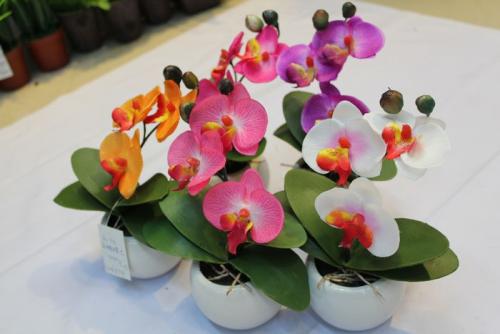
In most homes, even if the temperature is adequate, the humidity is not (except in places like the US state of Florida, or humid hot regions like Taiwan, China). Therefore many people who specialize in growing orchids have a greenhouse. If you don't have a greenhouse, you can frequently mist the surroundings with a spray bottle, or place several pots of flowers together to increase humidity. Another method is to place the pot on a shallow tray, put small pebbles in the shallow tray, add some water, and let the water release moisture. However, you must never let the bottom of the pot touch the water surface, to avoid root rot.Even in winter the temperature must be above 18°C. During the day, even in summer, it is best not to let it get too high; 24 to 27°C is most suitable (75 to 80°F).
For an orchid to bloom, it must have light. But the Phalaenopsis orchid does not like direct sunlight; after all, in the rainforest there is shade. So a window with light indoors is very suitable; morning or afternoon light is best, rather than the strong light at noon (you can use a gauze curtain to block the light). Also note that there must be light in winter too, so that the next season's blooming will be better. But if the indoor light is insufficient, you can supplement it with a fluorescent lamp, about 1,000 units of light intensity, at a distance of one foot, which is enough. (The light must be turned off at night.)
As for fertilizing, apply orchid fertilizer or a balanced fertilizer about once a month. Because there is no potting soil, you must use a weak fertilizer. Pause fertilizing during blooming and after the blooming period.
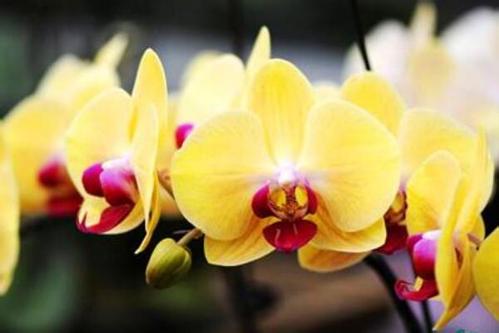
Many people don't know how to care for the plant after the flowers fade. In fact, you just need to let it rest, and follow the watering and fertilizing methods above, and it will bloom again the next year. If you see that the roots have grown too much and the pot is no longer big enough to hold them, you can repot it. Or if the potting medium has already broken down and become mushy over time, you can also repot and replant it. When repotting, you can check whether any parts of the roots have rotted, and cut them off with clean scissors. (The scissors must be sterilized before use.)
Many people ask whether the flower spike of the Phalaenopsis orchid should be cut after it blooms.
The basic principle is that you only need to cut off the withered part of the flower spike; the green part does not need to be cut. This is because if the plant itself wants to bloom, it will grow a new flower spike. In addition, some orchids bloom again on the original spike, so not cutting the old stem is feasible.
However, for experienced growers, it depends on the situation. When the flowers have faded until only the last one or two remain, experienced people will use pruning at this time to make it bloom one more time. That is, count three nodes up from the base, and cut about half an inch above the node. If the plant is healthy enough, in about two or three weeks a short stem will grow here, and it will bloom a second time, with a blooming period of about one month. This second bloom has fewer flowers, but it is equivalent to extending the blooming period. (Use sterilized scissors, and the cut can be coated with any kind of fungicide such as sulfur powder to avoid infection, or you can just apply cinnamon powder to achieve a disinfecting effect. Plants that are too young are not suitable for this; they should be allowed to rest and grow.)
But if you see that after the flowers fade, new leaves are growing, then do not force it to bloom a second time; instead let it first grow new leaves, rest for a while, and then bloom. Most large-flowered Phalaenopsis orchids, including the pink and white ones, are of this type. Once the flowers fade, cut the flower spike off at the base, so that the plant will concentrate its energy on growing new leaves and store up strength for the next blooming. The plant will also become stronger.
There are also some species Phalaenopsis orchids whose flowers always bloom on the same flower spike, so there is even less need to cut it. So when buying, you can ask clearly. (The safest thing is to cut off only the withered part.)
Now you know how to plant a Phalaenopsis orchid. So when you run into something you don't know, you should also know what to do. I hope the Phalaenopsis orchid you grow stays healthy.