How strong is the adaptability of coneflower? You will understand after reading this.
The family and genus of coneflower
Coneflower is a perennial herbaceous plant of the genus Echinacea in the family Asteraceae.
Alternative names for coneflower
Coneflower is also called purple coneflower, Echinacea, and purple echinacea.
The origin of coneflower
It is mainly distributed in North America and is cultivated in many places around the world.
In China, it is mainly distributed in Shanxi, Hebei, Inner Mongolia, Shaanxi, Qinghai, Gansu, Xinjiang (Shanshan), and other places.
Coneflower grows in terrains such as mountain slopes, hills, plains, farmland, and wasteland. It is also distributed in Central Asia and Siberia of the Soviet Union, Mongolia, and Iran.
The morphological characteristics of coneflower
The plant height of coneflower is 50-150 cm. The whole plant has coarse hairs, and the stem is upright.
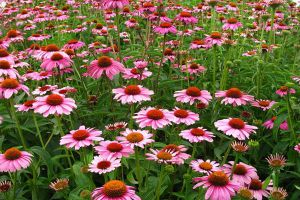
The basal leaves are ovate or triangular, and the stem leaves are ovate-lanceolate. The flower head is solitary at the top of the branch, the flower is relatively large, and the corolla diameter is between 8-13 cm. The central part protrudes in a spherical shape, and the tubular flowers on the sphere are orange-yellow. The outer part consists of ligulate petals, which may be red, pink, bicolor, white, and so on.
The flowering period of coneflower is from June to July. The seeds mature in late October, have a relatively hard outer coat, and are light brown.