What is the personality of the pitcher plant? Let us walk you through the details.
The pitcher plant is a perennial carnivorous herb with a relatively large size and elegant bearing. It attracts insects by secreting nectar, and insects that fall into the pitcher are digested. As a novel carnivorous plant, it is loved by many flower enthusiasts.
Pitcher plant genus and family
Ericales, Sarraceniaceae, Sarracenia, Latin scientific name:Sarracenia
Pitcher plant origin
Native to the marshes of North America, it is distributed throughout the Atlantic coastal regions.
Pitcher plant morphological characteristics
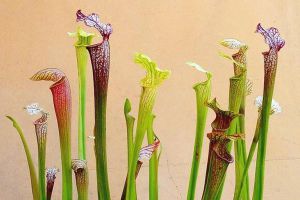
The pitcher plant has no stem, its leaves form a rosette, and the leaves are pitcher-shaped, upright or leaning to one side. The leaf surface has brilliant spots or patterns and is translucent; insects mistake these patterns for an exit and thus become trapped in the maze-like leaves. The leaves also have downward-pointing hairs, making it difficult for insects to crawl out after falling in, and the digestive fluid in the pitcher quickly digests the insects. The flowers of the pitcher plant are purple or green-purple, solitary and nodding, with a flowering period from April to May.
Pitcher plant growth habits
The pitcher plant likes warm, humid environments, tolerates cold but fears heat, and a relatively large day-night temperature difference helps it grow quickly; when the temperature is not too high, the pitcher plant can be placed in direct sunlight, which helps its coloration, and the reticulated patterns around the pitcher become very beautiful once colored; the roots of the pitcher plant have high requirements for water temperature and need to be kept at a relatively low temperature. The water can first be sunned in the sunlight, then placed in a shaded spot to cool, and afterward poured onto the plant's roots.