Did you know that the hare's-foot fern also has a floral name?
The hare's-foot fern has an elegant form, and both its rhizomes and fronds have extremely high ornamental value. It is currently a very popular indoor ornamental fern on the flower market. Come and get to know this adorable plant with us!
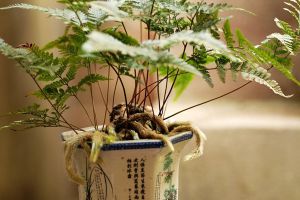
Scientific Classification of the Hare's-foot Fern
Order Polypodiales, Family Davalliaceae, Genus Davallia
Other Names for the Hare's-foot Fern
Dragon's-claw fern, rabbit's-foot fern, Latin scientific name:Dauallia bullata
Morphological Characteristics of the Hare's-foot Fern
The hare's-foot fern is a small epiphytic fern, with a plant height of about 20cm. Its stems are thick and sturdy, and its branches trail outside the flower pot. The rhizomes are exposed on the surface, covered with brown scales and hairs, just like a rabbit's foot, which is why it is also called the rabbit's-foot fern. The fronds are broadly ovate-triangular, pinnately compound, leathery, with a glossy surface, smooth and deep green.
Growth Habits of the Hare's-foot Fern
The hare's-foot fern has high temperature requirements; it tolerates neither high nor low temperatures. Its suitable growth temperature is 20°C-26°C. Above 30°C or below 15°C, its growth will slow down or stop, and in winter it must not go below 5°C. The hare's-foot fern likes warm, dry environments and is not cold-tolerant; it prefers loose, fertile, well-drained sandy loam soil. In winter it needs to be moved into a greenhouse to overwinter, with the greenhouse kept at around 5°C to prevent frost damage.
Uses of the Hare's-foot Fern
The hare's-foot fern is planted in tall pots or hanging baskets, with its creeping stems hanging down, giving the whole plant a very graceful form; it can also be planted as a landscape plant beside rockeries and rocks, and it is also very suitable as an accent plant for moss micro-landscapes. In addition, its rhizomes can be used as medicine, with effects of clearing heat and detoxifying, and dispelling wind and dampness.