Orostachys fimbriata
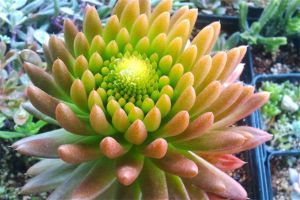
Orostachys fimbriata
Orostachys fimbriata has the same habits as Sedum lineare 'Variegatum' - it easily forms clusters, the main body dies after flowering, and it reproduces from seed the following spring. The advantage of growing Orostachys fimbriata is that spring to autumn is a full life cycle, letting you experience its entire process of growth, flowering and setting seed.
Other names for Orostachys fimbriata
Liúsū wǎsōng, wǎhuā, xiàngtiāncǎo, tiānwáng tiětǎ cǎo
Morphological characteristics of Orostachys fimbriata
Orostachys fimbriata grows 10-40 cm tall. The stem is slightly slanting, and the whole plant is powdery green. (Within the genus Orostachys, there is Orostachys lateriflora, which appears pink or dark red.)
The basal leaves form a tight rosette, linear to oblanceolate, 2-3 cm long, green with purple, or with a white powder, the margins having fringed cartilaginous pieces and 1 needle-like spine.
The leaves on the stem are linear to obovate, with long pointed tips.
The pedicels branch, arising laterally on the stem, densely covered with linear or long oblanceolate bracts; the flowers form a terminal, plump, spike-like panicle, while on young plants they are loosely arranged, forming a corymbose panicle.
Growth habits of Orostachys fimbriata
Among succulents, Orostachys fimbriata has a relatively short lifespan. One spring, summer, autumn and winter make up one cycle of life.
Wild Orostachys fimbriata grows on stony hillsides and rocks, as well as on the roofs of tile houses or thatched houses. It is widely distributed on sunny slopes in deep mountains, in rock crevices, and also grows in the cracks of old roof tiles. It is cold-hardy and drought-tolerant.
Home care techniques are simple and easy to grow. The flowering period is July to September. The fruiting period is August to October.
Uses of Orostachys fimbriata
Ornamental: Around the Dragon Boat Festival, the bulbs of Orostachys fimbriata grow to the size of a thumb; picked whole with roots and planted in clusters in a small pot, it is very charming placed on a balcony. Especially when tied with string and hung bare indoors, it grows into a U shape, decorating the interior in a very unique way.
Medicinal: According to the Tang Bencao, Orostachys fimbriata tastes sour, is neutral in nature and non-toxic.
Orostachys fimbriata can be used for clearing heat and detoxifying, stopping bleeding, draining dampness, reducing swelling, and more.