Jingye
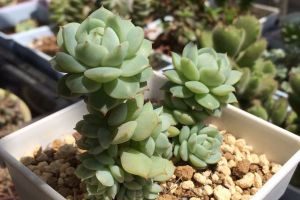
The characteristics of Jingye
Jingye is a small variety, with a single rosette 6-8mm in diameter, though there is also a large Jingye that can grow to 12mm in diameter. The leaves are light green with a touch of red at the tips. The leaves are obovate or wedge-shaped, with short points and a white bloom, and the leaf margins and tips usually carry a faint or pale red color.
The growth habits of Jingye
During summer, when temperatures are high and sunlight is intense, it easily scorches to death, and it also fears moisture, so it should be placed in partial shade and watered less.
When applying medication or watering, be careful and it is best not to accidentally spray the leaves.
A lack of light causes etiolation, with the stem stretching upward and the leaves becoming loose and unattractive, so try to give it as much sunlight as possible.
It grows rather slowly on its own, but it readily forms clusters, and the clustered effect is quite good.
The care and cultivation of Jingye
The flowering period is from late spring to early summer.
It needs full sun, but in summer take care to avoid intense direct sunlight.
Water after the soil has dried out completely. Spring and autumn are the growing seasons, and it is generally watered once every 1-2 weeks; summer and winter are the dormant seasons, and watering should be reduced to prevent root rot.
It should be placed in a well-lit, well-ventilated environment, avoiding water accumulating in the center of the leaves; no watering is needed on cloudy and rainy days.