How do Aeonium succulents get through summer? Master 3 key tips to make it through summer smoothly
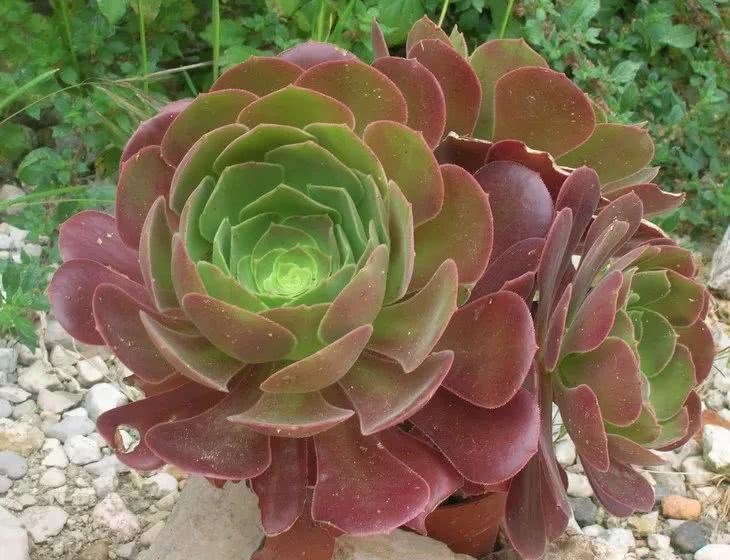
Aeonium, which is what we commonly call "mage" and mountain rose, is a rather special group within the Crassulaceae succulents.
The reason I say this is because they have a dormancy habit different from other Crassulaceae plants, while almost all other Crassulaceae succulents in Chinese home growing environments either do not go dormant or show an extremely mild dormancy response.
The dormancy of succulents has always been a confusing matter for many flower lovers. Because most succulents that show a dormancy response go dormant very punctually every year in their native habitat, we associate their dormancy response with dates in order to recognize them. If a succulent goes dormant in summer and grows in winter, we call it a winter-growing type. Conversely, if a succulent goes dormant in winter and grows in summer, we call it a summer-growing type.
However, everyone must firmly remember one thing: these terms winter-growing type and summer-growing type are just names given to them relative to the climate characteristics of their native habitat. This does not mean the succulents can really understand what winter is and what summer is.
Saying it this way may be hard for everyone to understand, so let me give an example from everyday life. We all know that if people travel to Europe or the Americas, they will experience jet lag after getting off the plane. Why does jet lag happen? Because when it is daytime in Europe and the Americas, it is just nighttime in China. After we fly to the other side of the globe, our body's biological rhythm is disrupted, so we need a period of rest to adapt to the new time. This period of rest is called getting over jet lag.
But here comes the problem: can our bodies really perceive changes in the Earth's time zones? To figure out this question, someone specifically conducted an experiment. The subjects participating in the experiment were required to live in a completely sealed, windowless house for 1 week.
During this week, the subjects lived a "completely normal" daily life. The reason I put the words completely normal in quotation marks is because the subjects did not know that the researchers had tampered with the clocks the subjects used. Through this week of enclosed living, they had already completely reversed the subjects' day and night.
When the week of living ended, the subjects were stunned as soon as they left the sealed room, because they thought it was now nighttime, but when they went out they found it was daytime outside, and jet lag immediately appeared. This reaction was exactly the same as the feeling of flying from China to the United States. Yet in fact they had not left the test room even one step.
The example I gave is meant to show that what causes our jet lag is not a real change in time zone, but simply that our rhythm of getting up and going to sleep has been disrupted.
Succulents are the same. They do not know how to read a calendar. What affects their dormancy response is simply the climate conditions of their native habitat.
So which climate factors exactly cause the dormancy response of Aeonium? Let us take a general look at the climate characteristics of the Aeonium's hometown, the Canary Islands.
The Canary Islands are made up of 7 different islands, located roughly at the northwest corner of the African continent. The island closest to the African continent is only 90 kilometers away from the mainland.
Overall, the Canary Islands have a Mediterranean climate. When we studied geography in middle school, we learned that the characteristic of a Mediterranean climate is warm, rainy winters and hot, dry summers. In the Canary Islands, the entire summer (the three months of June, July, and August) has almost no rainfall at all. This annual summer cut-off of water cultivated in the Aeonium living in the Canary Islands a clear summer dormancy response.
Actually, although we say the summer in the Canary Islands is hot and dry, this heat simply cannot compare with the summer in our Celestial Empire. Around the Canary Islands there is the cold Canary Current, which keeps the summer there from getting very hot no matter what. The minimum temperature only rises to around 22°C, and the maximum temperature only rises to around 30°C.
For other varieties of succulents, a temperature of 22-30°C is just right for growth. But for Aeonium of the genus Aeonium, they have already foreseen the arrival of the dry season through temperature changes, and they are preparing to get through the dry season by going dormant.
By this point everyone should understand: the key factor causing the dormancy response of Aeonium is temperature. When the nighttime minimum temperature remains above 15°C for a period of time, Aeonium begin preparing for dormancy. If the nighttime minimum temperature remains at 20°C, then Aeonium will enter dormancy.
Of course, the 15°C and 20°C above are relatively general statements and can only be used as reference values. The terrain of the Canary Islands is rather complex, and the temperatures of the various islands are not the same. Moreover, most of the Aeonium we see now are hybrid varieties, and their habits will also differ somewhat from wild varieties.
Some flower lovers feel that Aeonium are especially hard to care for when dormant, and hope to give them air conditioning in summer, expecting them to stay awake the whole summer and not go dormant.
This wish is quite nice, but I think there is no need to do this.
First of all, the various super beautiful pictures of Aeonium we see online every day are actually mostly photos of Aeonium in the dormant state. During the growing season, the rosettes of Aeonium are often green and loose, and their beauty is greatly reduced.
I remember that a paper did a quantitative study on the dormancy period of plants in the genus Aeonium. The conclusion of the study was that during dormancy the roots of Aeonium absorb one quarter of the carbon dioxide they absorb during the non-dormant period. In other words, we can simply consider that Aeonium in winter grow 4 times faster than Aeonium in summer.
Conversely, Aeonium grow in both winter and summer. Their dormancy is not complete; their growth rate merely slows down.
After all the groundwork above, I can finally state the three important tips for getting Aeonium through summer.
First, do not actively cut off water.
Aeonium decide whether to go dormant by perceiving changes in temperature, so do not actively cut off water for Aeonium just because summer has arrived. You should gradually reduce the amount of watering according to the condition of the Aeonium. If they grow fast, water more; if they grow slowly, water less. The minimum amount of watering should not be less than one quarter of the winter watering amount. This is because Aeonium do not go completely dormant; they are still continuously growing.
Second, do not deliberately try to prevent Aeonium from going dormant.
When the nighttime minimum temperature continuously reaches 15°C, the dormancy response begins; when it continuously reaches 20°C, they go dormant. This is definitely a rather harsh condition. In China, even in the Northeast region, if you want to keep the nighttime minimum temperature below 20°C in summer, I estimate that only the Northeast, the Northwest, and some cities in Yunnan have this condition.
Temporarily moving Aeonium into an air-conditioned room at night can easily cause physiological disorders in the Aeonium, leading to various strange problems such as wilting and leaf drop. So if the city you live in is one of those cities with high summer temperatures, then do not deliberately change the environment.
Third, understand the body language of Aeonium
Whether Aeonium are growing vigorously and whether they need watering can all be seen from the appearance of the Aeonium.
The Aeonium in the picture above is a dormant Aeonium with excessive light. The rosette becoming smaller and the number of leaves decreasing means excessive light. If the rosette becomes very large and the leaves are elongated, and the spacing between leaves is also elongated, then it is excessive shading. Adjust the light level according to the form of the Aeonium.
Some Aeonium have relatively closed rosettes when dormant. Various rose Aeonium and various mountain roses belong to this type of variety. The leaves of Aeonium being closed does not mean the leaves can be soft. We can still pinch the leaves of the Aeonium from the side to see how hard the leaves are. If the leaves are soft, it means the Aeonium is short of water.
As we said earlier, when dormant, Aeonium only need about one quarter of the watering amount of the growing season, and that is enough. More water is something Aeonium cannot enjoy; it will cause water accumulation and root rot, and may ultimately lead to black rot and stem rot.
How should one quarter of the watering amount be applied? The pots for Aeonium are generally relatively deep and relatively large. If previously we watered 1 liter every 10 days, then during dormancy we can water 125 milliliters every 5 days, that is, 250 milliliters every 10 days, which is exactly one quarter of the watering amount.
Not actively cutting off water, not deliberately preventing dormancy, and providing personalized service according to the actual condition of the Aeonium: these are the three tips for getting Aeonium through summer that I wanted to talk about this morning. Of course, for mountain roses, these three tips work just the same.