Bulbous flowers bloom into colorful lanterns in spring. I never expected them to grow so well in pots.
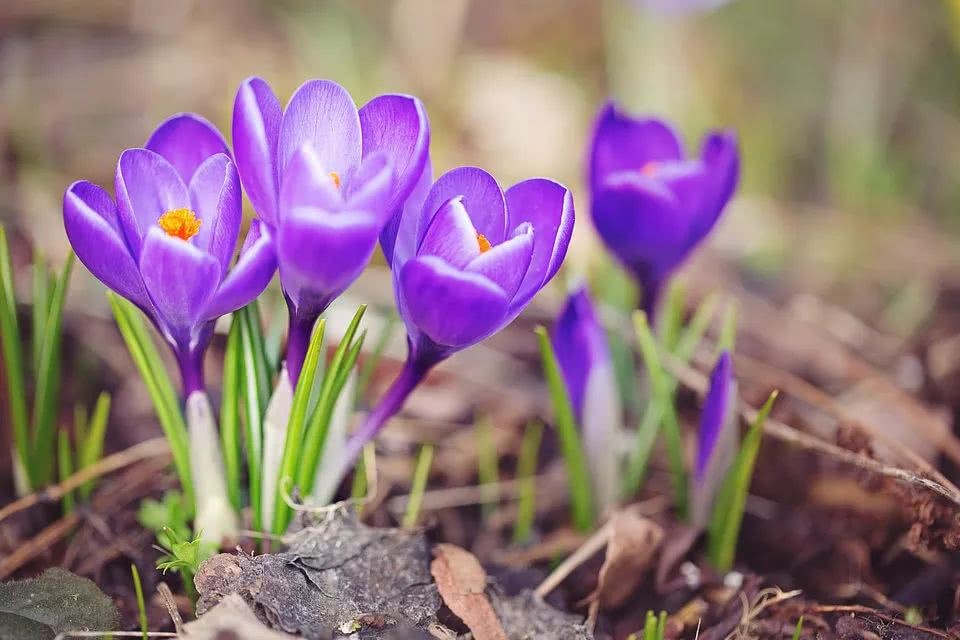
Below I will introduce a very beautiful and charming spring flower. It belongs to the bulbous flowers and has small lantern-like blooms. It is the crocus (Crocus), which begins to sprout and grow after the snow and ice melt. It is a relatively cold-tolerant plant, its care is simple, and it can also be grown in pots.
Crocus is also called saffron crocus (Crocus sativus). It is a perennial plant propagated by corms. Crocus and iris are related to some extent. Crocus comes in a rich range of colors, including the common white, pink, purple, yellow and mixed colors.
Crocus can grow beneath trees and in coastal gardens, lawns and similar environments, where it can form large patches. Crocus has charming flower colors and generally blooms in early spring, though some varieties bloom in late autumn or early winter, so you can pay attention to this when buying corms.
Crocus has strong adaptability and is very suitable for pot cultivation. It can also be planted in flower beds, under trees or in lawns.
There are many crocus varieties, as many as more than 80, though of course many are hybrid ornamental varieties. Usually only about 30 varieties are commonly seen. Hybrid varieties bloom a little later, but their flowering period is a bit longer.
Crocus is a very charming bulbous flower. Most bloom in spring. Some varieties are very small plants and are especially suitable for pot cultivation. They do not demand much from the environment, but there are still some planting techniques to note, and they should be grown in a suitable environment.
1. Growing environment
Crocus has a certain degree of cold tolerance, and the cold tolerance varies depending on the species. Some crocus can grow well even in winter, and crocus needs to be kept in a low-temperature environment for about 12 to 15 weeks in order to bloom the following year. However, this low-temperature environment refers to 2 to 7 degrees. Temperatures below zero are not ideal either.
When crocus grows into a large patch and blooms throughout the garden, the patches of pink and purple flowers look very natural and fresh, and the ornamental value is excellent.
The flowering period of crocus varies depending on the variety, but most stop blooming after summer temperatures rise.
Spring-blooming crocus varieties should be planted in early autumn. The growing location should have plenty of sunlight, and the environment should remain well ventilated. When blooming in spring, crocus leaves become very few and the flowers grow large, so the ornamental value is quite good. In summer, it should be grown in a shaded location so it grows better.
2. Notes on soil and watering
Cultivating crocus requires neutral or slightly acidic soil, but the most important thing is to maintain good soil drainage and avoid waterlogged soil, especially when summer temperatures are high. At this time, crocus enters dormancy, so watering should be properly controlled.
The planting depth for crocus is generally about 10 cm. Be sure to face the pointed tip of the corm upward so it can root and sprout normally. However, placing the corm flat is also acceptable, and it will grow toward the sunny side.
When planting, appropriately add bone meal or decomposed organic fertilizer beneath the soil, which helps promote crocus flowering.
Crocus does not need frequent care. Regular watering is needed only during the spring and autumn growing seasons. No watering is needed in winter, and during summer dormancy the soil should be kept dry, with no watering needed either. Crocus also does not need much fertilizer, so its care is especially simple.
Crocus stores its energy in the corm, which is why it can continue to resume growth in autumn or spring after its leaves turn yellow. In autumn, you can appropriately supplement some bone meal fertilizer to promote better crocus flowering the following year.
3. Propagation and pests and diseases
Crocus corms will grow side shoots, but there is no need to rush to divide them. Let them continue growing. However, once the crocus leaves on the main stem begin to decline, you can carry out appropriate division and separate these corms.
Crocus sometimes also gets infected by pathogens, which causes the crocus to grow crooked or even fail to sprout. This is generally caused by overwatering. Too much water easily leads to corm rot and fungal infection.
When caring for crocus, be sure to control watering. It does not need frequent management. Simply grow it in a ventilated place with plenty of light. In summer, provide appropriate shade, and in winter maintain a suitable low temperature (1 to 7 degrees). When growing in pots, crocus can be planted together with daffodils for better ornamental value.