Bonsai Basics: How to Read the Expression and Mood of Landscape Bonsai
Introduction: Hello everyone, I'm Little Gourd, and welcome to my article. Today I'd like to share with you the expressive forms of landscape bonsai. Landscape bonsai, also known as rock bonsai, uses stones as the main subject and, through techniques such as sawing, carving and joining, arranges plants or ornaments, fills a shallow pot with water, and typically recreates the spirit and appearance of natural landscapes as a work of art. Many friends love bonsai. As the saying goes, laypeople watch the excitement while experts watch the craft. With the same bonsai, some people can see its composition and understand the mood it intends to express, while others simply find it attractive but cannot say why. Let's read the expression of bonsai together below and see what it is trying to convey.
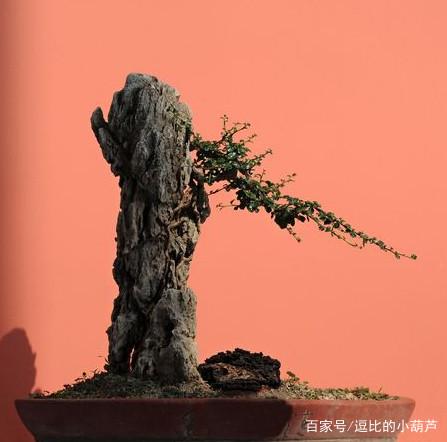
The solitary peak style of bonsai is generally used to present a relatively concentrated natural close-up scene. Its composition is generally fairly simple and lively. Usually a single artistically worked stone is placed in the pot, with a rather graceful shape and relatively large size. Sometimes, if a single tall stone feels too plain, a few relatively smaller stones can be added to set it off. The pots commonly used for solitary peak bonsai are generally round and oval.
Having covered the solitary peak style, let's move on to the next fairly common one, the weighted-to-one-side style. The weighted-to-one-side style is often used to present the steep, majestic and expansive natural scenery of mountain ranges. It consists of two groups of rocks, and these two groups differ greatly in volume, creating an obvious contrast: one tall and one short, one dominant and one secondary, placed at the two ends of the pot, expressing a distinctive mood through contrast.
The upright mountain style has a fairly similar expressive effect to the weighted-to-one-side style, but its expressive technique is quite different. The upright mountain style's vertical form is rather special, and it can be combined with any form in a flat layout. The axis of the peak stones and the lines of the texture strokes are mostly perpendicular to the pot surface, so the mountain peaks presented are steep, like sheer walls standing a thousand fathoms high, and very spectacular. That's all for today on these three expressive forms of bonsai. Tomorrow I'll continue with other expressive forms. Bonsai is an art and also a field of knowledge, and Little Gourd is happy to share some bonsai knowledge with you every day and enjoy the pleasure bonsai brings.