A Comprehensive Guide to the Past and Present of Dancing Mountain Forest
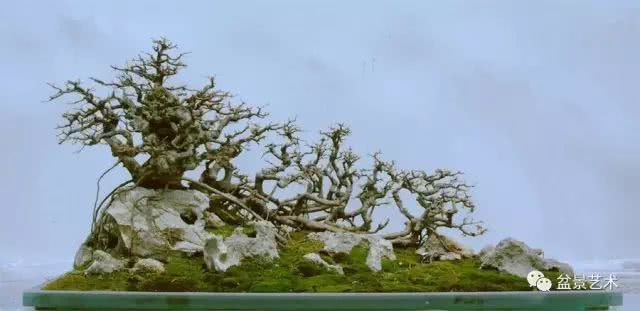
I love bonsai because it lets me place my feelings in trees and stones, seek nature's purity, and feel the richness of life. As the trees grow, I experience the tenacity of life and the wonder of the changing seasons. "Dancing Mountain Forest" is a work I am quite fond of. After ten years together, the tree and I have come to know each other, and our bond is deep. Looking back on its two creative processes, I have many reflections. Here I have arranged the images and written this text as a memento, and I give special thanks to Mr. Wu Laishun, who gave me the fine material. It was his sincerity and trust that made this work possible.
Clever Use of Borrowing, Giving Meaning Through Form
Ten years ago, this trident maple had already become a work, titled "Pastoral Song of the Mountain Forest" (Fig. 1). My good friend Mr. Wu Laishun cultivated it for many years, and it won a gold award at the 3rd Anhui Provincial Bonsai Exhibition. It is a tree-and-stone work. The trident maple is a twin-trunk tree, and the lower part of the main trunk is hollow. The author cleverly used stones to compensate, and at the same time arranged stones to create a landscape, expressing the effect of "roots clasping spirit stones" and shaping a scene of wild mountain forest full of rustic charm. It can truly be called ingenious.
Fig. 1 Pastoral Song of the Mountain Forest, trident maple, limestone, pot length 150 cm, created by Wu Laishun, photographed in 2005 at the 3rd Anhui Provincial Bonsai Exhibition
This stump is extremely rare and can be called a naturally extraordinary material. Growing from a single base, it rises and falls in staggered heights, with primary and secondary elements clearly distinguished. More than 10 secondary trunks interlock like dog teeth, surging with momentum, intricately varied, each with its own posture, connected in vein and spirit, moving in the same direction, coordinated and echoing one another, with a strong sense of motion. From left to right, following the flow downward, it is like charging soldiers, one after another, advancing bravely; it is also like a river pouring down, rushing and surging, roaring to the heavens... It brings endless reverie.
Inspired by it, I decided to make use of the "momentum" and rework the tree as the main subject. I worked hard on the word "forest" and made an effort with the word "motion" in order to deepen its physical charm. I first changed it into a deep pot 120 cm long for further cultivation (Fig. 2), striving to balance landscape creation and stump cultivation, and removed most of the stones, keeping only the main stone and a few small accent stones. The purpose was to apply the "spacing" principle from painting theory, enhance strengths and avoid weaknesses, and fully reveal all the connected branches and trunks that give the tree its strong flowing momentum, thereby showing its beauty.
Fig. 2 Computer restoration of the tree's appearance at the time of repotting. The messy branches will be sorted out; the short red lines are the pruning points on the branches. The purpose is to break, at the macro level, the flat and monotonous planes and outline, and to keep the rise and fall of the tree's vein and spirit smooth.
Dividing Into Sections, Cultivating Separately
The original stump had more than 10 small trunks, from top to bottom, forming a row, interlaced and mixed, unclear in order. The first step in reworking was to sort out the skeleton. According to primary-secondary and principal-subordinate relationships, from the top trunk to the tail, from top to bottom, advancing by retreating. First, at the macro level, break the flat and monotonous planes and outline, find order within the chaos, and identify the secondary branch crowns that coordinate and echo with the main body. When pruning, the premise is to keep the tree's vein and spirit smooth. Large branches that affect the overall macro structure, no matter how good their line variation, are not spared and are resolutely cut off. After this treatment, the crown becomes undulating and staggered, with proper density and sparseness. Second, settle on the roots and branches, carry out micro-level sorting, remove excess and interlaced branch forks, and achieve smoothness and unity (Figs. 2-3).
Fig. 3 After pruning, the branches become orderly and powerful. The 3 roots floating on the stone at the lower left front are very thin and weak, but they are very important and precious. They are the guarantee for carrying the tree's energy and achieving stability. Their existence concerns the quality of the work, and next they must be specially cultivated. The floating root on the right is long and stiff, temporarily retained as a sacrifice root, with the purpose of supporting the cultivation of the upper branches, to be removed after the tree body is perfected. The top of the original main trunk is thin and weak and needs to be reshaped. To ensure nutrient supply, the floating root on the right is temporarily retained, to be removed after the tree body is perfected. (During the cultivation period of bonsai, the cultivation of roots and trunks and the sealing of "horse eyes" often rely on the growth of "sacrifice branches" and "sacrifice roots" to quickly achieve the goal of perfecting the shape.)。
The trident maple has strong tree vigor and grows quickly. At different creative stages, the shaping techniques and maintenance methods used are also different. In summary, in the early stage, wiring and cultivation are primary, while in the later stage, pruning and control are primary.
In the first 3 years, the main goals were to restore the tree's vigor and cultivate transition branches. In terms of maintenance, heavy water and heavy fertilizer were used to make the branches thicken rapidly. For upright-growing branches, metal wire was used to wire and position them when semi-lignified, achieving the shaping goal.
After the skeleton is positioned, the contradiction shifts, and the goal is no longer the proliferation of individual branches. At this time, what should be considered is the fullness of the overall branch pads, with balanced control as the main approach, mostly adopting bud thinning, pinching, leaf plucking, and pruning to shape the tree.
Bonsai creation cannot be rushed or violate natural laws. One can only follow the principles of nature, cleverly borrow the meaning of heavenly work, guide according to circumstances, and proceed step by step. After 6 years of nurturing, the work gradually revealed its elegance in 2011 (Fig. 4). In 2012, the focus of shaping was the cultivation of the tail branches. After 3 rounds of pinching, leaf plucking, and pruning, the tree form matured day by day (Figs. 5-7). In winter it was brilliantly adorned and dazzling (Fig. 8); after leaf fall, it was firm and resolute, nimble and stretched (Fig. 9).
Fig. 4 The crown structure is complete, only waiting for the small branches to fill in. Photographed on March 30, 2011
Fig. 5 After the lower floating root (sacrifice root) was cut off, the root's vein and spirit appear more continuous. Apart from the still-weak top, the other branches are already relatively full. Photographed on March 21, 2012
Fig. 6 New leaves first unfolding, with a distinctive charm. Photographed on March 28, 2012
Fig. 7 Autumn leaves emerging again after all leaves were plucked and pruning was done in late August. The leaves are small and neat, preparing for the future colorful display. Photographed on October 25, 2012
Fig. 8 Frost dyes the maple grove into intoxication. Under the winter light, the mountain forest is colorful and enchanting. Photographed on November 30, 2012
Fig. 9 The tree's appearance after winter pruning. The branch veins are clear and smooth, and the overall tree vigor moves because of the branches; motion produces rhythm, and motion "raises sound." The "sound" is among the trees, like surging waves, and also like ten thousand horses galloping, majestic and spectacular. In November 2014, the work won the silver award at the "First China Cup Bonsai Competition." But the dignified pot made the terrain less visible, affecting the wild charm of the mountain forest.
Environment Is Created by the Mind, Changing the Pot Adds Brilliance
In November 2014, "Dancing Mountain Forest" participated in the "First China Cup Bonsai Competition" and won the silver award (Fig. 10). Although it won an award, the pot had always made me feel regretful. Its heaviness constrained the expression of the work's pictorial conception. After the exhibition, I immediately contacted Mr. Zhu Shuiming and ordered a new pot. The new pot was custom-made according to the changes in the stump material and the needs of the habitat: first, the pot had to be shallow, "having a pot without making the pot prominent," in order to set off the changes in the mountain forest terrain; second, the outer lines of the vessel form had to rise and fall and flow, and should not be regular; third, the color had to be simple and elegant, ancient and dignified, and should not be ornate.
Fig. 10 Shallow pot, grand scenery, wild charm standing out. Tree photo at the time of winning the gold award at the "2015 International Bonsai Convention and Asia-Pacific Bonsai and Suiseki Convention." Photographed on September 18, 2015
Five months later, after changing to the new pot, the work took on a completely new appearance. Because the new pot's volume and surface area were much smaller than the original pot, the lofty aura of the mountain forest immediately appeared.
As the saying goes in the trade, "first the scenery, second the pot, third the stand." Once the scenery and pot are complete, a suitable stand is still needed to set them off. Traditional tables and stands are too refined, and pairing them with this rough-styled work would instead spoil the effect. I specially asked Mr. Li Huanchu and Mr. Liao Shixiang, root-art artists from Xiaogan, Hubei, to help find dead stumps with varied shapes and cut them into stands. Relying on their natural appearance and original color, the "scenery, pot, and stand" become a trinity, harmonious and full of interest.
In September of the same year, at the "2015 International Bonsai Convention and Asia-Pacific Bonsai and Suiseki Convention" held in Guangzhou, "Dancing Mountain Forest" won the gold award (Fig. 11). Being able to gain recognition from expert judges at such a high-level bonsai exhibition, besides the maturity of the tree's shaping, the changed pot and stand also played a great role in setting off the artistic conception.
Fig. 11 A few days later the red leaves first unfolded. This is the tree photo before the exhibition was dismantled. Photographed on September 24, 2015
The trident maple can be called the nobility among broadleaf trees. The grace and spirit it shows in different seasons each have their own merits, and before leaf fall it is especially red, splendid, and charming. Appreciating the colorful tree form and feeling the dancing soul, ten years of hard work vanish like smoke, leaving in the heart only spiritual insight and emotional elevation. This is the greatest reward for a bonsai creator.
In-Depth Reading
Related Reading