Although this grass is a bit annoying, it is a treasure.
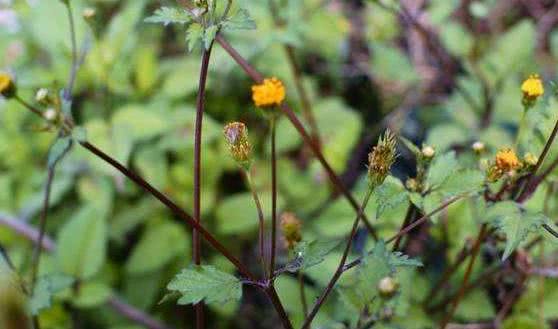
Bidens pilosa, also called shrimp-claw grass, sticky grass, and opposite-leaf grass, is found across many provinces in China. Its tips often bear 3-4 awns, and most importantly it has barbed hooks, so it clings very easily to people. It is an annual herb, 90 cm tall, upright, much branched, and the whole plant is hairless, with a square green stem and mostly pale purple nodes. The leaves are opposite, stalked, about 3 cm long, pinnately divided into 3-5 leaflets, dark green on the surface and grayish green and glossy on the underside. The flowers bloom at the tips of branches or in the leaf axils, with stalks 3-6 cm long. They are arranged in a corymb-like head, with yellow tubular florets in the center. The fruits are numerous, about 1.2 cm long, dark brown, narrowly linear with 4 angles, and the upper part has recurved prickles, needle-like, spreading by attaching to animals. The flower heads are arranged in an umbel-like form, terminal or axillary, with long stalks; the involucre is green with fine hairs at the base, the ray florets are white and 4-7 in number, and the tubular florets are bisexual, yellow, and five-lobed. There are five stamens and one pistil, with the stigma divided into two. The whole plant is hairless, the stem is green, upright, square, and much branched, often with pale purple at the nodes, and the plant is about 30-100 cm tall. The leaves are opposite, with stalks about 3 cm long, trifoliolate or five-leafleted, and the leaflets are ovate or ovate-elliptic, acute or acuminate at the tip.
Bidens pilosa is actually a commonly used folk herbal medicine. It is warm in nature and bitter in taste, entering the liver, lung, and large intestine meridians. The whole plant can be used as medicine, and it has effects such as clearing heat and detoxifying, reducing swelling and dispersing blood stasis. In recent years, research has found that Bidens pilosa actually has a dual-direction regulating effect on blood pressure: it can lower blood pressure in hypertension and raise blood pressure in hypotension. Bidens pilosa can also treat many diseases. Migraine: 1 liang of Bidens pilosa plus 3 jujubes, decocted in water and taken warm. Stomach qi pain: 1 liang 5 qian of fresh Bidens pilosa plus 4 liang of fresh pork, stewed over fire, with a little seasoning wine added, taken before meals. Traumatic injury: 1-2 liang of fresh Bidens pilosa, decocted in water, with 1 liang of yellow rice wine added, taken warm, once daily. Cold with fever, sore throat, etc.: this is even simpler, 1 liang of Bidens pilosa, decocted and taken. Bleeding from incised wounds: fresh Bidens pilosa, pounded directly and applied externally to the wound.
Bidens pilosa is treated as a weed by farmers because it competes with crops for water, nutrients, and light, reducing crop yield and quality. In fact, Bidens pilosa is a medicinal herb, and the whole plant can be used as medicine. It has effects such as clearing heat, detoxifying, dispersing blood stasis, and reducing swelling, and it also has a dual-direction regulating effect on blood pressure. Bidens pilosa can clear heat and detoxify, disperse blood stasis and reduce swelling, and has a good therapeutic effect on upper respiratory tract infections and tonsillitis. Bidens pilosa is a commonly used folk herbal medicine in China. It is warm in nature, bitter in taste, and non-toxic. The whole plant can be used as medicine, and it has effects such as clearing heat, detoxifying, dispersing blood stasis, and reducing swelling. People commonly use it to treat diseases such as enteritis and dysentery. In recent years, it has been found that this medicine has a good biphasic regulating effect on blood pressure. Patients with hypertension can have their blood pressure lowered after taking this medicine, and those with lower blood pressure can have their blood pressure raised to normal after taking it. Clinically, it is mostly used to lower blood pressure. Using Bidens pilosa to lower blood pressure is not only safe and reliable, but can also avoid the side effect of sexual dysfunction caused by certain antihypertensive drugs.
Sticky grass, also called sticky herb or large-leaf tick clover, is a kind of leguminous plant. This plant mostly grows in Taiwan, China, Guangdong, and Yunnan, China, and other places. Its roots can be used as medicine, mostly harvested in summer and autumn. After harvesting, the soil and sand are removed and it is sun-dried, which is then the Chinese medicine sticky grass. Chinese medicine sticky grass is sweet in taste, slightly pungent, and mild in nature. It has various effects such as reducing inflammation and regulating menstruation and relieving pain. It is usually used to treat irregular menstruation, uterine prolapse, amenorrhea, and abdominal pain in women, and its therapeutic effect is very obvious. During treatment, 20 to 40 grams of sticky grass can be directly decocted with clear water and then taken. Sticky grass can also be used externally. It can clear heat and detoxify, and has an obvious therapeutic effect on common psoriasis and neurodermatitis in humans. During treatment, sticky grass can be decocted with water; after decocting, the medicinal liquid is taken out and then concentrated into a paste. Finally, the prepared paste is applied directly to the areas with psoriasis or neurodermatitis, 2 to 3 times a day, and the symptoms can be reduced after a few days.