Growing flowers always ends in failure? Are these two plants easy to grow?
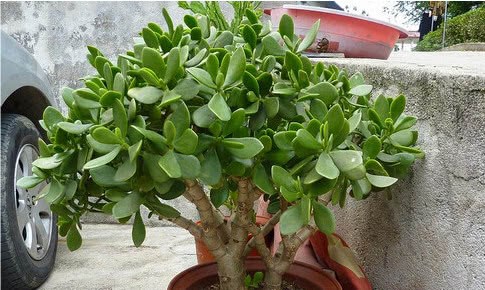
Jade Plant (Crassula ovata (Mill.) Druce), also known as jade tree, sedum tree, fleshy evergeen, and doubanzhang, is a plant of the genus Crassula in the family Crassulaceae, a succulent. Its branches and leaves are thick and fleshy, evergreen all year round, with unusual leaf shapes and a stately plant form. It is easy to cultivate and simple to manage. It is suitable for pot culture and can be displayed on a balcony or as an accent on an indoor side table, looking very elegant and refined. The jade plant has a multi-branched subshrub form, with obvious, round stems, green or yellowish-brown bark, and small dots on the leaves. The fleshy leaves are opposite, densely growing at the top of the stem or branches, fleshy, long ovate, slightly curved inward, with a slight leaf tip, green to red-green in color, glossy. When the temperature difference is large, the leaf edges turn red while the leaf centers stay green, which is very beautiful. Under controlled watering and strong light, the whole plant takes on a very attractive red-green color; under ordinary cultivation the color is green with a bit of red edge; when light is insufficient, the plant turns green and the internodes stretch out. The flowers are in clusters, and the small flowers usually have five petals, white or white-pink.
Evergreen small shrub. The stem is cylindrical; the old stems are woody and grayish-green, while the young branches are green. The leaves are long elliptical, opposite, flat, fleshy, entire, slightly pointed at the tip, somewhat spoon-shaped, 3-5 cm long and 2-3 cm wide, with a glossy emerald-green color. It blooms in summer and autumn, with five petals, and the corymbose inflorescences bear white or light red flowers. If the jade plant is placed in a spot with plenty of sunlight and grown outdoors, the leaf edges will turn red. For potted jade plants, it is best to use a mix of 2/3 leaf mold and 1/3 garden soil with a small amount of river sand as the growing medium, and a little horn shavings or other slow-release fertilizer can be placed at the bottom of the pot as a base fertilizer. To help with drainage, some crushed stone or tile pieces should also be placed at the bottom of the pot. From spring to autumn, water once every 1-2 days, but avoid water accumulating in the pot. In the intense heat of summer, when the temperature reaches above 30°C, the plant enters a dormant or semi-dormant state and watering should be controlled. At the same time, shade and cooling measures should be taken; the ground around the pot can be sprayed with water 2-3 times a day, and attention should be paid to ventilation. The optimal relative air humidity is 40-60%. The optimal growing temperature is 15°C-32°C; it fears high temperatures and stuffiness, and enters dormancy in the intense summer heat when the temperature is above 33°C. It fears cold and frost, and the overwintering temperature needs to be kept above 10°C. In winter, when the temperature drops below 7°C it also enters dormancy, and if the ambient temperature approaches 4°C, it will die from frost injury.
Broadleaf Lady Palm (scientific name: Rhapis excelsa (Thunb.) Henry ex Rehd.), also known as Guanyin bamboo, jintou bamboo, palm bamboo, and dwarf ground rattan, is an evergreen foliage plant of the genus Rhapis in the family Arecaceae. It has leaf nodes covered with leaf sheaths that bear brown reticulate fibers. It is a clumping shrub, 2-3 m tall, with upright cylindrical stems that are jointed, 1.5-3 cm in diameter; the stems are slender like fingers, unbranched, with leaf nodes, the upper part covered by leaf sheaths, but these break down into somewhat loose, horsehair-like, pale black, rough and hard reticulate fibers. It is a clumping shrub, 2-3 m tall, with upright cylindrical stems that are jointed, 1.5-3 cm in diameter; the stems are slender like fingers, unbranched, with leaf nodes, the upper part covered by leaf sheaths, but these break down into somewhat loose, horsehair-like, pale black, rough and hard reticulate fibers.
The leaves are clustered at the top of the stem, palmately parted, with 4-10 unequal segments, bearing 2-5 ribs, united at the base (that is, at the top of the petiole) for 1-4 cm, 20-32 cm long or longer, 1.5-5 cm wide, broadly linear or linear-elliptic, broad at the apex, truncate and with several pairs of slightly deeper small lobes, with slightly sharp serrations on the margins and ribs, and many obvious transverse veinlets; the petiole is slender, about 8-20 cm, convex on both sides or slightly flat above, slightly rough at the margins, about 4 mm wide, and the small hastula at the apex is somewhat semicircular or obtusely triangular, hairy. The spadix is axillary, about 30 cm long, with small, pale yellow flowers, very numerous, unisexual, and dioecious. The peduncle of the whole inflorescence and the bases of the branched inflorescences are each enclosed by 1 spathe, densely covered with brown curled tomentum; there are 2-3 branched inflorescences, which bear small flower spikes branched 1-2 times, the flowering branches nearly hairless, and the flowers spirally arranged on the small flowering branches. The male flowers are ovate-oblong in bud, with a pointed tip; at maturity the corolla tube elongates, and at flowering they are club-shaped oblong, 5-6 mm long, with a cup-shaped calyx deeply 3-lobed, the lobes semi-ovate, the corolla 3-lobed, the lobes triangular, the filaments thick and enlarged above with a keel-like ridge, and the anthers cordate or cordate-oblong, blunt or slightly notched at the apex; the female flowers are short and thick, 4 mm long.