Such a beautiful flower, I've lived half my life and seen it for the first time, have you ever seen it?
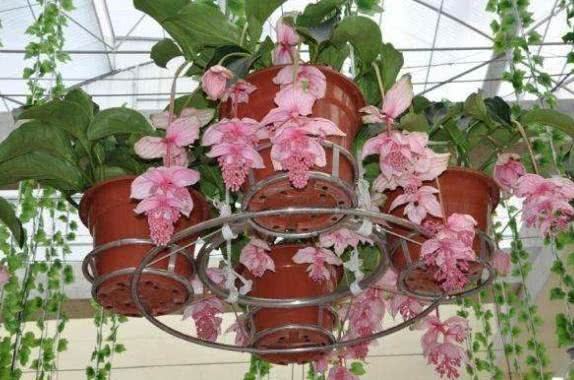
The Medinilla is a beautiful flowering shrub that originates from the Philippines region and is suitable for potted cultivation and ornamental display. It is known as the most luxurious member of the Melastomataceae family. Medinilla, also called pearl Medinilla, Medinilla magnifica, Medinilla, magnificent acid-foot stem, Medinilla flower, pink-bracted acid-foot stem. Medinilla likes loose and fertile leaf mold or peat soil, and care should be taken to keep the soil moist, but during the flowering period, the humidity should not be too high. Every spring, it can be repotted. Medinilla's ornamental value is still quite high; its plant form is elegant, and it blooms with pink flowers that are very vibrant, so it is very suitable for indoor ornamental display. Potted Medinilla can generally be placed in hotels, halls and living rooms, etc., as decoration. The flower language of Medinilla is mature and pure beauty.
There are approximately more than 300 varieties of Medinilla flowers. Their forms and sizes all differ. But as for the common general Medinilla flower, in tropical regions the Medinilla flower can grow to 1.5 m. As an indoor houseplant, it generally grows to about 50 cm tall. The flowers face downward, hanging in spikes, and the petals are pink. The Medinilla flower's plant form is very elegant, like a shy girl bowing her head. It is also the most beautiful and most beloved flower in the Melastomataceae family. This plant is very suitable for placing in spacious areas. Does everyone know its flower language? Perhaps quite a few flower lovers know it. But for most friends, it may not be very clear. This flower's flower language is also full of a mystical quality, implying luxury and a sense of mystery. Indeed, in my view, the flower language of the Medinilla flower suits it very well. This lantern flower's appearance is also very gorgeous. The sense of mystery is embodied in the continuously wrapped flower buds. Moreover, mystery is also very suitable for describing people. If a person possesses both a gorgeous appearance and a faint mysterious temperament, it can be said to be very attractive. You should know that having a mysterious temperament is very good; many people want to have such a temperament themselves, to make themselves stand out.
Trailing Abutilon (Latin scientific name: Abutilon megapotamicum), also known as hanging bell flower, is an evergreen trailing plant, with soft branches and vines, and heart-shaped green leaves that dance gracefully. The flowers are peculiar, growing in the leaf axils, with long pedicels, hanging downward, with heart-shaped red sepals, and petals closed, protruding from the calyx, with brown stamens extending out of the petals, shaped like a wind chime, with a delicate and charming posture, bright colors, swaying in the wind, dynamic and graceful, bright and lovely, one could say "a wind chime among green leaves, revealing its lovely face as it sways." Aliases: trailing Abutilon, red-sepaled Abutilon, lantern wind chime, red heart spitting gold, weeping-branch wind chime flower, lantern wind chime, lantern hibiscus, wind chime hibiscus, Brazilian Abutilon, red-sepaled Abutilon, trailing bellflower, etc. trailing. The wind chime flower is also called hanging bell flower, red heart spitting gold, lantern wind chime, trailing bellflower, etc.; the overall impression it gives people is very festive, with red wind chimes blooming among the green plants, which is also very pleasant, so its ornamental value is very high. If cultivated properly, it can be in its flowering period all four seasons.
Trailing Abutilon is a light-loving plant. Normally it likes to grow in an environment with sufficient sunlight, and the time it receives light each day cannot be less than four hours. Only in this way can it grow well. When growing Trailing Abutilon indoors, it can be placed on a sunny balcony or windowsill. Trailing Abutilon is an ornamental plant that likes a warm environment. When growing it normally, it should be placed in an environment above 10 degrees. If you want Trailing Abutilon to grow vigorously, you must control the indoor environment to between 20 and 25 degrees. If the room temperature is below 15 degrees, it will grow slowly. When growing Trailing Abutilon normally, be sure to pay attention to the supply of fertilizer. Spring, summer and autumn each year are the growing seasons of Trailing Abutilon. At this time, sufficient fertilizer should be given, preferably by applying a compound fertilizer once every 15 days. But after entering winter, it will enter a growth dormancy period, and at this time fertilization must be stopped. In addition, when growing Trailing Abutilon, its branches should also be pinched back in time, so that it can grow more branches and bloom more beautiful flowers.
Lily of the Valley (scientific name: Convallaria majalis Linn.), also known as Junying grass, lily of the valley, bellflower. It has a sweet scent and the whole plant is toxic. It is a perennial herb. The plant is short, the whole plant is hairless, and underground there are multi-branched and creeping flat rhizomes. It is glossy. It is sheath-shaped and embraces each other, with several sheath-like membranous scales at the base. The leaves are elliptical or ovate-lanceolate, the flowers are bell-shaped, hanging, in racemes, the bracts are lanceolate, membranous, and the style is shorter than the perianth. In autumn it bears round dark red berries, which are toxic, containing elliptical seeds that are flat. The flowering and fruiting period is May to July. Besides the common white flowers, the varieties include large-flowered lily of the valley and red-flowered lily of the valley. Especially the large-flowered lily of the valley, in April it will extend curved and elegant pedicels from a pair of dark green long elliptical leaves, blooming fragrant pure white flowers; besides single-petaled ones, there are also double-petaled lily of the valley varieties; some horticultural hybrids show variegated leaves, called variegated lily of the valley. The lily of the valley plant is short, elegant and clear, with a pleasant fragrance, and is an excellent potted ornamental plant, usually used in flower beds and flower borders, and can also be used as ground cover plants. Its leaves are often used as cut flower material. There are varieties such as milky white, pink and variegated leaves. In autumn, the red berries are delicate and charming, very alluring. Lily of the valley is the flower of the goddess of sunrise in ancient Norse mythology, a fresh flower used to offer to the goddess of sunrise. Lily of the valley is also the sacred flower of the North American Indians. The romantic French also have a special "Lily of the Valley Festival." On the "Lily of the Valley Festival" in May, French people give each other small lily of the valley flowers, symbolizing good fortune and good luck.