How to care for succulents in summer? Four sun-loving varieties recommended
Summer is coming. Flower lovers who want to grow a few sun-loving succulents in this season, please open your eyes wide and take a look at the introduction I have prepared for you below. Among the huge succulent family, there are many that, although they love sunlight, are not necessarily all suitable for growing in summer.
The four succulent varieties below were specially introduced by a friend who has grown succulents for many years. They are sunny, lively, and easy to grow, making them the top choice of plant varieties for lazy people and for decorating office areas.
1. Cuban oregano
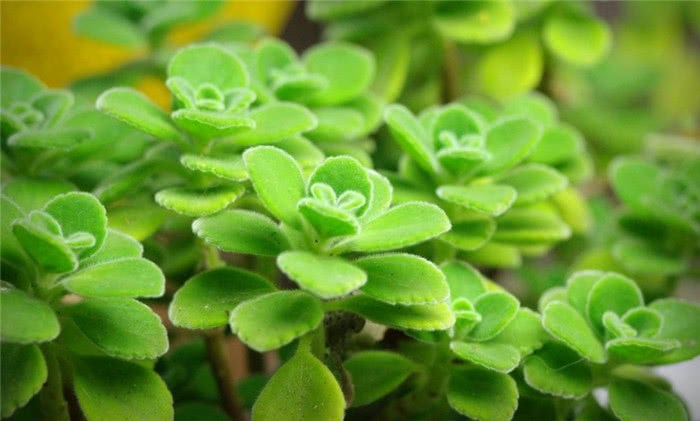
Cuban oregano (Plectranthus amboinicus) is a shrub-like perennial herbaceous plant variety in the Lamiaceae family, genus Plectranthus. Its place of origin is Europe, the Cape of Good Hope in Africa, and southwestern Asia. It is a trailing succulent plant. Its stems are brown, and its young stems are green. The leaves of Cuban oregano are fleshy, ovate or obovate in shape, smooth and flat, with sparse teeth along the edges, and alternate. The whole plant is covered with fine white fuzz. It gets its name because after touching it with your finger, a fresh apple-like fragrance remains on your hand. Cuban oregano is a succulent variety that loves sunlight and can receive full sun all year round, though it is also shade-tolerant. It likes warmth and fears cold, and the minimum growing temperature in winter must not be lower than 0°C. It is suitable for planting in loose, breathable loam with good drainage, and water must not accumulate in the pot. As for watering, Cuban oregano is drought-tolerant and fears excessive moisture. Watering should follow the principle of watering thoroughly after the soil dries out, and it is better to keep it dry than wet. As for fertilizer, apply a little diluted fertilizer every few days; do not apply too much, as too much will cause root rot.
2. Echeveria 'Purpusorum'
Echeveria 'Purpusorum' is a perennial succulent plant variety in the Crassulaceae family, genus Echeveria. Its fleshy leaves are arranged in a tight rosette. The leaf shape is broadly ovate or deltoid-ovate, with the back protruding in a keel shape. The leaves are about 3-4 cm long and about 3 cm wide, with an acute tip. The leaf color is grayish-green, densely covered with red-brown markings, making it very ornamental. Echeveria 'Purpusorum' can bloom. The inflorescence is about 30 cm tall and can produce small flowers, yellow on top and red below, bright and eye-catching in color. Echeveria 'Purpusorum' is a plant variety that likes warmth and a well-ventilated environment. It is suitable for growing in fertile, loose sandy loam with good drainage. During the growing period, keep the soil on the dry side and water thoroughly after it dries out, but the humidity in the air needs to be maintained; you can spray some water around it regularly, and in winter you need to control watering. This is an easy-to-grow succulent that can tolerate full sunlight and also tolerate low temperatures of minus 5°C in winter. It likes a growing environment with good ventilation. Apply a decomposed, diluted liquid fertilizer once a month.
3. Crassula mesembryanthemoides
Crassula mesembryanthemoides, also known as silver arrow, is a perennial succulent plant variety in the Crassulaceae family, genus Crassula. It likes a warm, dry, and sunny growing environment and can receive full sunlight all year round, with no obvious dormant period, but it fears low temperatures, rain, and snow the most. The most common variety of Crassula mesembryanthemoides is green, but if the sunshine duration is long and the temperature difference between day and night is large, it can slowly change color and become even more ornamental. Its most suitable growing temperature is 15-25°C, and in winter it must not go below 5°C, otherwise it may freeze to death. It is suitable for growing in a mixed soil made of peat, vermiculite, and perlite, with fertility, looseness, and good breathability being best. It likes a growing environment with good ventilation and strong light. As for watering, water thoroughly after the soil dries out, and it is best to keep the soil on the dry side. Do not water in winter. During the growing period, fertilize once every two months.
4. Orostachys
Orostachys is a succulent plant variety in the Crassulaceae family, genus Orostachys. It is also a traditional Chinese medicine. The stems of Orostachys are slender and cylindrical, grayish-brown on the surface, with many protruding residual leaf bases and obvious longitudinal ridges. Unlike most succulents with flat, thick, and smooth leaves, the leaves of Orostachys are mostly fallen off, broken, or curled, and grayish-green in color. Orostachys has a paniculate inflorescence, and the small flowers are white or pink. It is brittle, easily broken, light in weight, with a slight odor, and tastes slightly acidic. Its effects include cooling blood and stopping bleeding, detoxifying, and promoting wound healing, among others. Orostachys is an extremely easy plant variety to grow. Its lifespan is very short, so there is no need to consider the problem of overwintering. It likes a growing environment with ample light and good ventilation, and is suitable for a loose, fertile growing environment with good drainage. This plant has quite good drought tolerance; the water stored in its scales is enough to support normal stem and leaf growth, and when its bulb withers, its growth cycle is over.
In short, these are several succulent plant varieties that do not show obvious dormancy in summer and can also receive full sunlight in this season. Unlike other varieties that need shading in summer, they are therefore easier to grow. If you are a beginner at growing flowers, or a lazy person who usually does not have much time to care for plants, you can start by considering growing them. With such strong vitality and quite high ornamental value, they are certain to contribute their own strength to beautifying your home.
How much more do you know about the topic of this article? You are welcome to share your views in the comment section below. If you like this article, you might as well subscribe, and more wonderful articles will be shared with you.