Key Points for Gibberellin Spraying on Watermelon and Its Application Methods in Cultivation
Gibberellin is a broad-spectrum plant growth regulator commonly used in agricultural production. Its physiological function is mainly to promote cell elongation and accelerate the growth and development of crops. It can also be used to induce and regulate the ratio of female to male flowers, increase the fruit-setting rate, break seed dormancy, and so on. Its effects are quite wide-ranging. So how exactly is it used in watermelon production? Let's talk about it below.
Preventing and treating stiff seedlings
In the few days before watermelon transplanting, adverse factors such as low temperature or root damage generally occur. There are many factors that cause stiff seedlings, such as insufficient water and fertilizer, and soil drought, which can lead to the appearance of stiff seedlings on a large scale. After transplanting, when the temperature in the seedling bed is below 15°C, stiff seedlings will occur. Regulating the climate is certainly not realistic, so at this time plant growth regulators can be used to break the stiff seedling condition. At this time, a 50-100 mg/L gibberellin solution can be chosen to spray the leaves of the seedlings, and results can be seen in 3-5 days. Although gibberellin can quickly improve the stiff seedling condition, it will cause the seedling leaves to turn yellow and become lighter in color. Therefore, while spraying gibberellin, some monopotassium phosphate can also be added.
Promoting more female flowers in watermelon
Watermelon begins to elongate its seedlings at the three-leaf stage and gradually begins female flower differentiation. Overall, watermelon has few female flowers and too many male flowers. Therefore, in order to make watermelon produce female flowers earlier, gibberellin spraying can be chosen. Dilute 4% gibberellin emulsifiable concentrate at 8000 times and spray on the leaves.
Preventing fruit cracking
After watermelon enters the ripening stage, once it encounters rainy weather or a sudden temperature change, fruit cracking will occur on a large scale. The following can be used:
15 mg/L indoleacetic acid, 15 mg/L gibberellin, 30 mg/L naphthaleneacetic acid and 8 mg/L cytokinin or their mixed solution
After watermelon flowering, spray once a week for treatment, which can effectively reduce the occurrence of fruit cracking in the later stage of watermelon.
Extending the storage period
Before watermelon harvest, spray the leaves with 4% gibberellin emulsifiable concentrate diluted 2000-4000 times, which can also effectively extend the storage period of watermelon.
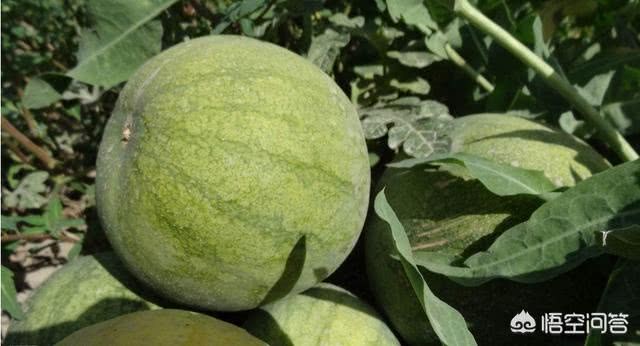
Back to the question raised by the original poster: whether gibberellin should be sprayed onto the watermelons themselves during application. From the above analysis, it can be seen that no matter what purpose gibberellin is sprayed for, spraying the leaves is sufficient. Of course, since it is field spraying, it is inevitable that the spray mist will also fall on the watermelons. These are all harmless. As a systemic auxin, gibberellin will produce its due effect no matter which part of the plant absorbs it.
The above is a point of view shared with you by Kexue Xingnong, for your reference.
This article is originally created by Kexue Xingnong, taking you to grow knowledge together.