Paul Thompson (Photo provided by the Department of Bio-Industry Communication and Development, National Taiwan University)
Avoid emphasizing a single stance; people must build their own capacity for making food choices For example, in Food: The Key Concepts (Chinese translation: "Food: Identity, Convenience and Responsibility"), Warren Belasco explores today's eating life from the dimensions of memory, gender, global supply chains, health and sustainability, and asks how people should choose food. Which dimension will people prioritize: "identity," "convenience" or "responsibility"? Of course, the author also clearly points out that "responsibility" may not be the strongest factor influencing food choices, but he believes that "responsibility" should be placed at the top, and suggests that consumers should give deeper consideration to the consequences of their choices.
In agriculture, Agriculture and Food in Crisis: Conflict, Resistance, and Renewal, edited by Fred Magdoff and Brian Tokar, takes the position of debunking the "free market myth," delving into agricultural production and energy, food sovereignty, land resilience and smallholder production issues, aiming to clarify the value of a new agri-food system in which "food is for people, not for commercial profit." Because these works take such clear positions, implying that a certain kind of food choice is "correct" or "moral," they inevitably create a sharply divided situation with liberals on the other end of the scale.
In Taiwan in recent years, debates and oppositions have also arisen between "small farmers vs. large farmers" and "real food vs. processed food," and this debate has even gradually evolved into an ideological binary conflict in which each side labels and accuses the other as "hipster nostalgia" or "commercial market ideology."
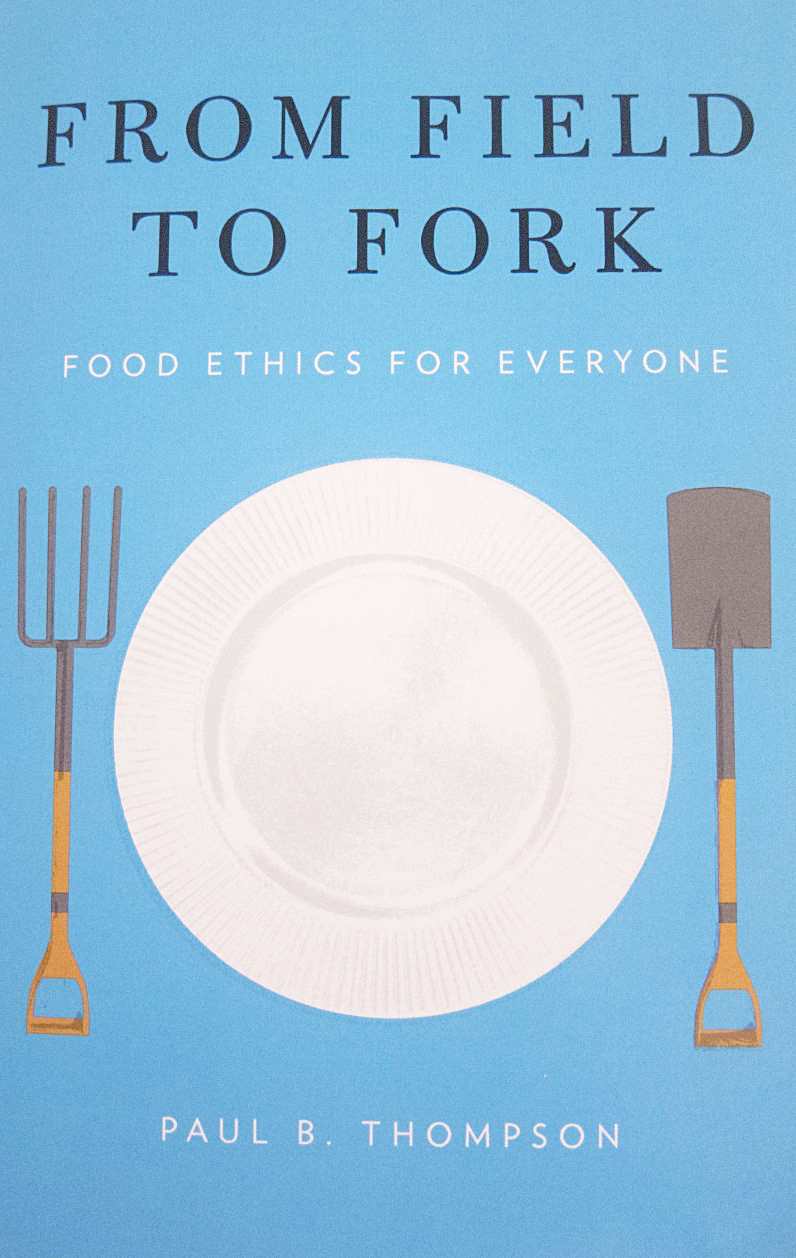
Among the various agri-food discourses in recent years, this book deliberately avoids overemphasizing a single stance from the outset. In the introduction, the author first explains that ethical judgments come from two kinds of constraints: law and policy, and morality and custom. Most ethical theories try to tell people how you should act and what is the "right" thing to do. Thompson, however, does not intend to do this. He believes that under today's complex food economy and supply system, people must build their own capacity for making food choices and think about what impacts personal dietary decisions may have on other humans, species or the environment.
The author believes that the contribution of philosophy to the study of food issues lies in raising questions and engaging in critical reflection, and in maintaining an open imagination about things.
Brief Chapter Guide Although in the introduction the author reviews important theories in Western ethics -- utilitarianism, contractualism, virtue theory and Habermas's discourse ethics -- the author does not intend to use any one theory to develop an account of food ethics. Instead, he borrows Dewey's learning theory to explain that what this book will show readers is "a process of questioning and critical reflection about food ethics, not an absolute answer."
Chapter 1 "You Are NOT What You Eat" The author reviews the history of philosophical theory and explores why food disappeared from the issues of philosophical concern. Ancient philosophical works often advised when to eat, how to eat and how much to eat, but from Plato to Aristotle onward, philosophy became increasingly concerned with reason, and therefore regarded bodily functions or sensations as not belonging to higher-level philosophical pursuits. Food was gradually assigned to the domain of nutritional science; food choice was regarded as a matter of personal taste, and as long as it did not endanger the public interest, it could not be accused of being immoral or unethical. This argument happens to align with Mill's On Liberty.
On the other hand, Marx's political economy approach also influenced the study of food ethics. Its proponents mainly concern themselves with the connection between food production and state management or institutions, and advocate fair distribution across classes.
The author believes that the ethics of food choice mainly centers on three issues: social justice in food, environmental ethics in food, and the logic of risk. "Social justice" concerns poverty, hunger and distribution, as well as the justice and responsibility of improving the "exploitation" of labor rights or ecological diversity from production to consumption. "Environmental ethics" concerns the impact of people's food choices on other species, holding that humans have a responsibility to protect the interests of all species on Earth, and that these interests should not be sacrificed merely to satisfy human interests. "Risk" refers not only to the impact of high technology or the food industry on human health and safety, but also to its impact on the traditions, practices and forms of social solidarity of agriculture or diet.
In the introduction and Chapter 1, the author provides a relatively in-depth introduction to and discussion of the theories of Marx and Mill, and in subsequent chapters these theoretical perspectives become core concepts in ethical reflection.
Chapter 2 "Food Ethics and Social Injustice" This chapter explores how to think ethically about the exploitative labor relations that commonly exist in the food industry system. In this chapter, the author highlights a set of opposing positions. Liberals or neoliberals argue that farmers and immigrants long for a job (even if low-paid), and even if they suffer misfortune, the employer cannot be accused of treating them unjustly. Those who take a social justice stance argue that the inequality and injustice brought by the food system of the industrial revolution and post-industrial society deepen class differences along lines of race, gender and ethnicity, and hinder social progress.
Since unjust things have existed for a long time, why have they received attention from the media and social activists in recent years? The author believes that "creating better social institutions" is a driving force for human social progress and reform since the Enlightenment, and that social movements for food justice such as food security and food sovereignty are precisely practices in pursuit of better social institutions.
Chapter 3 "The Ethics of Diet and Obesity" This chapter explores whether diet and obesity are a matter of personal choice or an ethical issue. The author traces the history of philosophical development, examining why the issue of dietary health, once of concern to medieval philosophy, disappeared from twentieth-century philosophy and ethics, and how the industrialized lifestyle and public health policies after the mid-twentieth century transformed obesity from an individual responsibility into a public issue.
The author believes that once we begin to think about diet and obesity from an ethical perspective, we may find that this is a moral issue for individuals or for society as a whole (or for specific groups, such as government and the food industry), and even that obesity, food security and the impact of food on the environment or biological species are not independent issues.
Chapter 4 "The Fundamental Problem of Food Ethics" This chapter discusses how to solve the problems of farmers' poverty, hunger and famine, and whether these are moral issues. Public opinion and research are more familiar with the former, and most arguments focus on two solutions. One is to give him a fish, namely the altruism advocated by Peter Singer, improving the problem through charitable donations or relief. The other is to give him a fishing rod, namely improving smallholders' technology, production efficiency, or helping them change careers to become wage laborers.
The author cites the research of Nobel Prize-winning economist Amartya Sen to explain that neither of the above two methods is the solution, because "hunger is often unrelated to production, but related to distribution." The author points out that poverty, hunger and famine are a moral issue, because unequal distribution has institutional roots. This understanding helps us elevate the solution to the level of reviewing institutions, structures and the industrial food production and marketing chain.
Chapter 5 "Livestock Welfare and the Ethics of Producing Meat" This chapter discusses an ancient philosophical question: whether eating meat is an ethical act. People choose vegetarianism for many reasons. The author first reviews the development of philosophy and points out that there are three clearly different issues worth discussing in the ethics of meat eating: First, morally, is eating meat and raising/slaughtering animals ethical? Second, morally, is the current way of raising livestock acceptable? Third, how should the current ways of raising livestock and producing meat be revised to improve animal welfare?
The first question is a debate dating back to ancient times, while the latter two are questions that emerged only after the industrialization of livestock farming. Because of resource distribution problems in modern society, low-income workers tend to choose a dietary pattern that is high in calories and relatively lacking in vegetables. Before the structure of food distribution can be adjusted, the author reminds us that regardless of whether vegetarianism is promoted on religious, animal protection or health grounds, greater ethical tolerance should be given to disadvantaged people who lack the power of choice.
Chapter 6 "The Allure of the Local: Food Systems and Environmental Impact" Continuing the context of the industrialized food production system from Chapter 5, this chapter directs the focus of ethical discussion to agricultural production, attempting to explore the issue of agricultural sustainability from the three dimensions of ecology, economy and society. The author believes that there are many ways to think about environmental philosophy. For example, from the perspective of functional integrity, we will see how today's food system affects people's actions within that system, and how food choices affect other people, animals and the environment, and whether such a social environment is the environment we want to use to cultivate the character and habits of the next generation. If we look at food ethics from the perspective of environmentalism or utilitarianism, we will take into account the needs of future generations and accept a vision of resource sustainability.
Read Chapters 7 and 8 Together Chapters 7 and 8 can be read together. Both chapters focus on today's food production technology, especially the ethics of genetic cloning. Chapter 7, "Green Revolution Food Technology and Its Discontents," summarizes and explains five reasons for opposing genetic cloning technology: risk management issues, social justice, violation of natural principles, individual food autonomy and morality. Chapter 8, "Once More, This Time with Feeling: Ethics, Risk, and the Future of Food," continues the discussion of genetic cloning technology from Chapter 7 from the perspectives of scientific rationality, professional knowledge and risk.
The author points out that under the philosophy of industrialism and liberalism, agricultural technology and biotechnology become tools that serve only production efficiency, making food merely a commodity. The author advocates an "agrarian" philosophical view opposed to industrialism. Under this philosophical view, agriculture is not merely a stage for technology, but a series of human practices and social institutions; food culture is even more a medium between people and the ecological system. Thompson believes that different philosophies of development will guide human society in different directions. Because of the characteristics of food, the author especially emphasizes at the end of the book the advocacy of resource sharing rather than a utilitarian stance. He hopes that humanity can develop a food system that conforms to social justice, sustainability and food sovereignty.
What are the ways of thinking about "the right choice"? Lévi-Strauss once famously said: "Many natural species are chosen not because they are good to eat but because they are good to think." This is precisely because eating is not only a matter of survival, but also a cultural act. In the face of increasingly developed industrial agriculture and commodified food, as well as overwhelming online marketing, people rarely take the time to pause and reflect.
And at a time when many food researchers are eager to tell readers how to make "the right food choice," what Thompson perhaps wants to say to readers through this book is: "Wait, let us first discuss the ways of thinking about so-called 'right choices.'" This is a good suggestion. The perspectives on environmental ethics, social justice and the risks of contemporary life discussed in this book, along with its brilliant dialectics, give the book high reading value, but readers are advised to also include the cultural option in the process of reading this book.
(This article was originally published in Journal of Chinese Dietary Culture, April 2017. Book Review "From Field to Fork: Food Ethics for Everyone." Journal of Chinese Dietary Culture, 13(1): 205-215. Reprinted after partial revision in Upstream and Downstream.)
Acknowledgments: For the completion of this article, I thank Li Qiuyun, Luo Youqi, Huang Jingyuan and Ye Yuzhen for participating in discussions and contributing their wisdom in the elective course "Food, Environment and Culture."
References
Magdoff, Fred, and Brian Tokar eds. 2010. Agriculture and Food in Crisis: Conflict, Resistance, and Renewal. NY: Monthly Review Press.