What kind of plant is the succulent Cereus fernambucensis?
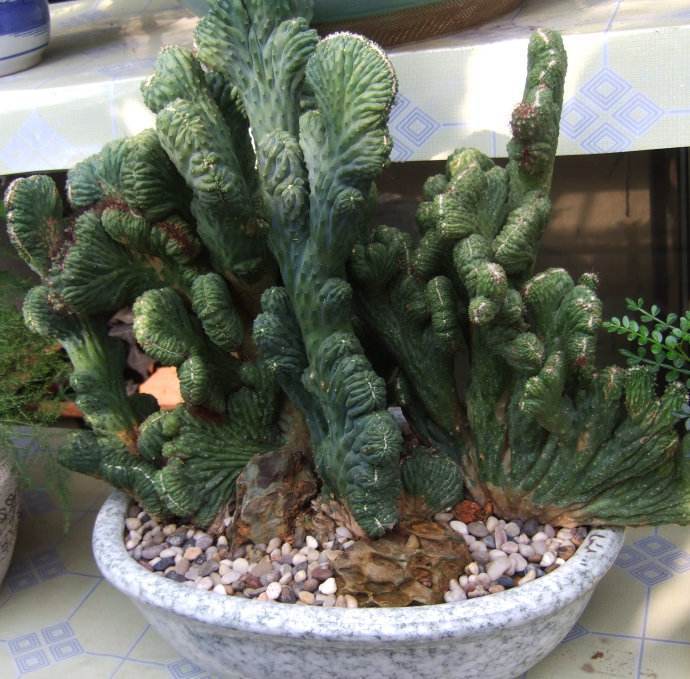
The morphology of Cereus fernambucensis resembles a mountain yet is not a mountain, resembles stone yet is not stone; rather, it is a living, lush, layered and overlapping, evergreen succulent. Because its form is towering and abrupt, resembling mountain ridges, it is named "Immortal Mountain." Depending on the variety of Cereus fernambucensis, the shape, number and color of its peaks vary, with distinctions commonly called "coarse code," "fine code" and "dense code." If planted in a purple-clay pot, Cereus fernambucensis resembles stone yet is not stone, evergreen all year round and full of vitality, just like a uniquely styled "rockery bonsai." It likes sunlight, is drought-tolerant, tolerant of poor soil, and also shade-tolerant. It is native to the West Indies, northern South America and eastern Argentina.
Cereus fernambucensis
Spring and autumn: These two seasons are its peak growing periods. Fertilizer and water management follows the cycle of "Huabao" -- clear water -- "Huabao" -- clear water, with intervals of approximately: 2 to 4 days for outdoor care; shorter intervals during sunny or high-temperature periods, longer intervals or no watering during rainy or low-temperature periods; 3 to 6 days for indoor care. Summer: During the high-temperature period in summer, it often enters a dormant state, has little demand for fertilizer and water, and may even need restricted fertilizer and water. Fertilizer and water management follows the cycle of "Huabao" -- clear water -- clear water -- "Huabao" -- clear water -- clear water, with intervals of approximately: 3 to 5 days for outdoor care. Watering should be done as much as possible in the morning or evening when temperatures are lower. The plant should also be misted frequently. Winter: During the winter dormant period, the main task is to control fertilizer and water, and watering should be done as much as possible at noon on sunny days when temperatures are higher.
Cereus fernambucensis
Covered cultivation
The reason Cereus fernambucensis grows rapidly under covered cultivation is multifaceted. Under covered conditions, the potting soil loses water slowly, which better maintains the slightly dry state that promotes rapid growth in Cereus fernambucensis and reduces damage to the plant caused by drought. Whether organic fertilizer or inorganic fertilizer, in a covered environment both can decompose better and exist in a form conducive to plant absorption. Because the nutrient supply is good, Cereus fernambucensis naturally grows vigorously.
Cereus fernambucensis