Freesias growing thin and weak like grass? Learn my method and they will bloom in a riot of colors
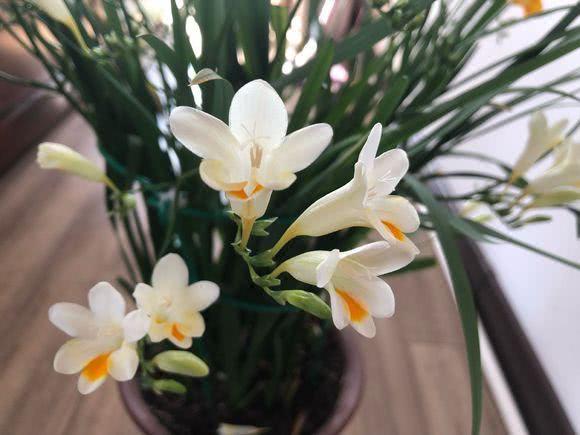
Freesia, also known as freesia, tuberose, and babiana, among other names, belongs to the Iridaceae family as a perennial herbaceous plant, native to the Cape of Good Hope region in southern Africa. The corms are ovoid, the stems slender and weak, about 40 cm tall, with slender, slightly twisted spikes, and the flowers mostly grow to one side or at an angle. The flowers are about 4 cm long, in many colors including bright red, goose yellow, pale yellow, pink, lilac, and white, and are fragrant. They are planted each autumn and bloom from February to May.
Counting on my fingers, I have been growing freesias for seven or eight years, and I love them very much. Because time and again in the harsh cold of winter, time and again at the Spring Festival, they bloom in succession, gorgeous and varied, with a faint delicate fragrance. They let you harvest, let you rejoice, let you feel warm.
Regarding the care and cultivation methods for freesias, I have seen quite a few from fellow gardeners. Some friends take out the corms in summer, some put them in the refrigerator, some soak them in XX; the planting methods also vary, some plant them only two or three centimeters deep, some even build trellises, some fertilize at any time, some add soil at any time... all sorts of approaches.
My method:
First, the corms are never taken out in summer, and remain buried in the original flower pot, but are not watered, just tossed under the table;
Second, when planting, dig them out, do no treatment whatsoever, just arrange them in order;
Third, the planting time is generally during the National Day period, and if the weather is warmer, mid-to-late October also works. Sometimes planting early without watering is also fine;
Fourth, the planting depth is nearly ten cm, and I mostly use orchid pots. So I have never built trellises for them, and when the flowers are in full bloom, occasionally a string to hold them back is enough;
Fifth, during the growing period, more light, less water, and appropriate cold tolerance, to let them grow thick and upright; if they grow too fast, they can be pruned appropriately;
Sixth, when planting, mix the fertilizer into the soil all at once (bean cake fertilizer and plant ash, etc.), and afterward never fertilize again.