Detailed explanation of a podocarpus bonsai creation example
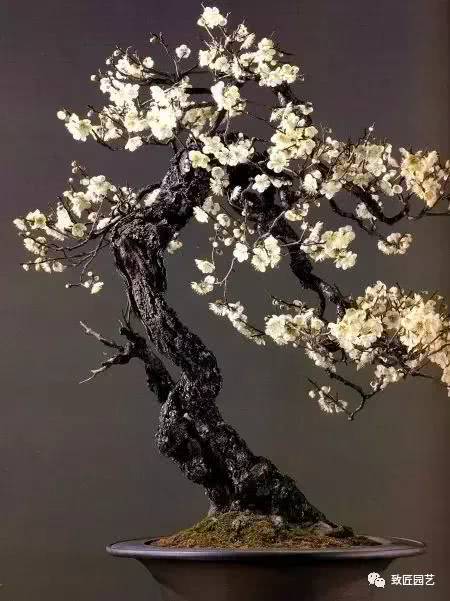
Plum blossoms are not only often planted in courtyards; the plum blossom is also a commonly used material in China for making flowering bonsai, with a long history of use in bonsai. Below, let us share the styling and production methods of plum blossom bonsai.
Plum blossoms have a cultivation history of more than 4,000 years in China. As far back as ancient books such as the Book of Songs and the Book of Documents, there were descriptions of plum blossoms. Plum blossom bonsai mainly appears in the form of stump scenery, and its forms, styling styles and methods vary from place to place. Many works have become representative works of major schools, such as the Huizhou school's Youlong Mei (that is, zigzag bend), the Suzhou school's Pimei, and the Sichuan school's Gunlong Baozhu Mei, all of which have fine works. Plum stump bonsai includes regular style and natural style. Traditional plum stumps are mostly regular style, and branch and trunk styling is mainly in forms such as curved-trunk style, split-trunk style and weeping-branch style; modern bonsai mostly develops ideas according to the material, styles along the natural tendency, and is smooth and natural, mainly in dead-peak style, slanting-trunk style and curved-trunk style.
The branches and trunk of the plum are sturdy and aged, and the tree shape is elegant. It blooms in the cold winter months. Even in ice and snow, it still has masses of blossoms, setting each other off with the snow, symbolizing purity, steadiness and unyielding integrity.
(1) Material selection for plum blossom bonsai
The propagation methods of plum blossoms include sowing, cuttings, grafting and layering. The most commonly used propagation method for plum blossoms is grafting, because this method is relatively quick for cultivating plum stumps. Seedlings grown from sown peach, apricot or plum can be used as rootstock. Before plum blossoms sprout in spring, choose strong one-year-old branches, cut them into 5 to 6 cm lengths, keep 2 to 3 buds on the upper part, and make a cut about 3 cm long. At a point 3 to 5 cm above the ground on the rootstock, cut off the upper part and carry out cut grafting. After grafting, cover with soil. After one month, loosen the covering soil, remove rootstock sprouts, and check whether it has survived. If it has survived, still bank the soil back up. You can also take buds from current-year branches in August or September for bud grafting. Check and observe one week after grafting; if green, plump buds appear, it indicates that it has survived. Plum blossoms are generally cultivated in the open ground for several years and are potted only after they have grown into a certain tree shape.
For cultivating plum stump bonsai material, grafting and layering are mostly used. If plum stumps are cultivated from a young age, sloping land is often chosen, and peach, wild peach, apricot, wild apricot or plum is sown to cultivate seedlings as rootstock. In Jiangnan, cut grafting and side grafting are mostly carried out before spring sprouting, or side grafting is carried out around the Autumn Equinox. In the north, branch grafting is mostly carried out, or square bud grafting is carried out during the End of Heat and White Dew periods.
(2) Styling of plum blossom bonsai
For curved-trunk plum bonsai cultivated from a young age, coir rope binding is often used, with coarse binding and coarse pruning. The main trunk of the plum blossom bonsai is bound once each year to create one bend, and ordinary management is relatively extensive. The branches of plum blossom bonsai can be bound, but more pruning should be done. After the plum blossom bonsai blooms each year, thin out branches and comprehensively organize the tree shape of the plum blossom bonsai; for short pruning, light pruning is mainly used, as excessive heavy pruning will affect flowering the following year; before flowering, thin out diseased branches, dead branches and water sprouts on the plum blossom bonsai.
Cultivating plum blossom bonsai from a young age takes a long time. In order to obtain stump material quickly, you can dig up natural wild plum stumps, single-petal fruit plum stumps, or wild apricot or apricot tree stumps to use as stump rootstock. Those growing on cliffs and steep slopes, beside mountain paths, or near village entrances and homes, with ancient and simple stump heads, are best. Use a hand saw to cut off all branches of the tree stump above the positions to be retained, and use a chopping knife to cut off the remaining branches of the tree stump with multiple cuts; in this way, aged and ancient traces can be formed. Dig the stump before leaf fall in autumn or before sprouting in spring, and move the trimmed ancient stump with a soil ball out for potting. Select fine-variety current-year branches and cut them into 10-20 cm sections as grafting scions, seal them with wax, and keep them ready for grafting. In order to quickly take shape for earlier viewing, the "three same-year" cultivation method can be adopted, SP: same-year transplanting, same-year grafting, same-year shaping. Grafting methods include cut grafting and bark insertion grafting. Cut grafting should be carried out before sprouting, and bark insertion grafting should be carried out when sprouting occurs after sap flow. After the chopped ancient stump has been cultivated and grown for one year, several branches grow out. Before grafting, select and retain good grafting positions by fixing branches, positions and directions, cut off the remaining branches, and carry out grafting. After survival, when new shoots grow to 30-40 cm, pinch the tips while retaining 20-30 cm. After two years of cultivation, the scene of dead wood coming back to life will appear. When changing or repotting the bonsai, plant it 5-10 cm higher than the original planting level and gradually expose the roots to form a styling of suspended roots and claw-like roots. '
In order to make one pot of plum blossom bonsai produce flowers of two different colors, double-color varieties such as "Fuban Tiaozhi", "Danban Tiaozhi" and "Midan Tiaozhi" can be selected, or double-color plum blossoms can be cultivated by artificial grafting.
Plum blossoms have a very long lifespan, reaching several hundred to about a thousand years. They like sunlight and a warm, humid climate, and have a certain cold resistance. They are not strict about soil requirements and are relatively tolerant of barren soil, and can grow normally in lightly alkaline soil; when planted in gravelly clay and gravelly loam with compact subsoil, plum branches are substantial and flowering and fruiting are abundant; while branches growing in loose sandy loam or sandy soil are often not substantial enough. Plum blossoms are averse to wind and afraid of waterlogging, and require well-drained soil, otherwise roots easily rot and the plant dies.
Wonderful content